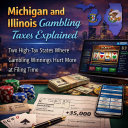
About this ebook
The most common situation is a California resident winning big on the Las Vegas Strip. No Nevada tax — great. But California taxes income earned anywhere in the world by its residents. The federal bill is separate. So what seems like a simple Vegas win ends up involving two or three layers of tax that most winners don't anticipate.
This guide explains how Nevada's no-income-tax structure works, the federal obligations every winner faces regardless of state, how Las Vegas casinos handle W-2G forms and withholding on the floor, and the California-Nevada situation that affects millions of visitors every year. There's also a practical walkthrough for out-of-state residents filing home-state returns on Nevada winnings.
If you've won in Vegas and you're wondering what you actually owe, this guide has your answer.
WHAT READERS WILL LEARN
Why Nevada takes nothing — how the state funds itself through casino taxes on operators, not players
What federal tax you owe on a Vegas win — W-2G thresholds, withholding procedures, and filing steps
How your home state taxes Vegas winnings — most states tax residents on income earned anywhere
The California-Nevada situation — one of the most common and most misunderstood gambling tax scenarios
How to get your W-2G documents from Las Vegas casinos before you leave or after you return home
A complete federal-only filing walkthrough for Nevada residents who only owe federal tax on their casino wins
Discover more
About the author
The author is the editor of casinoonlinegaming.com greenbaycasino.com and slotbonuses.info, where they publish educational articles analyzing casino games from a mathematical and probabilistic perspective. That work focuses on game structure, probability, and common misconceptions rather than betting advice, systems, or strategies.
Writing under the Games Explained Honestly imprint, the author specializes in clear, probability-first explanations of casino games and gambling mechanics. Rather than offering methods to win or promises of outcomes, the work examines how games are designed, how probabilities are fixed, and why player experience often conflicts with mathematical reality.
The books in this series draw on publicly available information, standard principles of probability, and established concepts from game design and behavioral psychology. They are written for readers who want understanding instead of folklore, clarity instead of illusion, and explanations grounded in structure rather than belief.
The author does not provide legal advice, gambling advice, financial advice, or recommendations. All content is educational in nature and intended to help readers better interpret chance-based games and their own experiences with them.