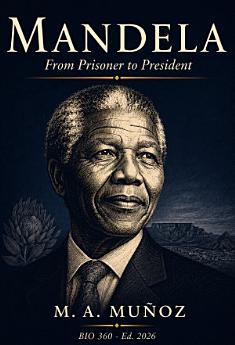
Mandela. From Prisoner to President
About this ebook
Two photographs of Nelson Mandela have settled into the canonical image the contemporary world holds of him. In the first he is a Johannesburg attorney in his thirties, sharp-suited, dignified, the educated African gentleman of mid-twentieth-century South Africa. In the second he is old, ninety-something, slowly smiling, a fragile shoulder bared by a shirt too large, a hand raised in the international salute of the political grandfather. Between those two extremes lie twenty-seven years in prison, five years as the president of a country he had once openly tried to overthrow, three marriages, the slow death of an epidemic that his successor refused to acknowledge, and the longest single political negotiation of the twentieth century.
In Mandela — From Prisoner to President, the tenth volume of the BIO360 collection of historical biographies, the author M. A. Muñoz presents the full life of Nelson Rolihlahla Mandela in thirteen chronological chapters and a substantial appendix. The book follows him from his birth in the Thembu royal house in 1918, through the mission schools and Fort Hare, into the Johannesburg years of the African National Congress Youth League and the Defiance Campaign of 1952, through the Treason Trial, the founding of Umkhonto we Sizwe in 1961, the Rivonia Trial and the 'I Am Prepared to Die' speech, the twenty-seven years in the prisons of Robben Island, Pollsmoor and Victor Verster, the secret talks with the apartheid government from 1985 onward, the public negotiations from 1990 to 1994, the single term as president, the eleven years as elder statesman, and the slow withdrawal that ended in the house at Houghton in December 2013.
The book takes neither the hagiographic route nor the recent skeptical revision. It treats Mandela as the complicated political figure he was: a man of substantial personal warmth and considerable political ego, capable of patience to the point of testing the saints and of unilateral abruptness when he judged the situation required it, holder of principles for which he was prepared to die and willing to compromise on questions of practical implementation in ways less serious politicians often consider beneath them. The book confronts honestly the debates that still surround his name: the founding decision of armed struggle, the relationship with the South African Communist Party, the marriage to Winnie and its political consequences, the mishandling of the AIDS epidemic, the corruption that has taken hold of the ANC under his successors, the persistent economic inequality that the transition did not resolve.
For readers who want to understand who Mandela actually was, without the heroic varnish and without the easy condemnation, this is the book to start with. It is the kind of book the BIO360 collection has been producing across its previous volumes (Attila, Cleopatra, Carlemagne, Leonardo, Pythagoras, Gandhi, Napoleon, Columbus): divulgative and clear, narrative without being decorative, rigorous with the evidence without being academic, honest about the moral weight of its subject without becoming a tract.
The tenth volume of the BIO360 collection of historical biographies, dedicated to the political and human life of one of the most influential figures of the twentieth century. From the boy named Rolihlahla in the Thembu royal house to the president of South Africa, with twenty-seven years of imprisonment in between. Honest, careful, narrative biography from the team behind the BIO360 collection.