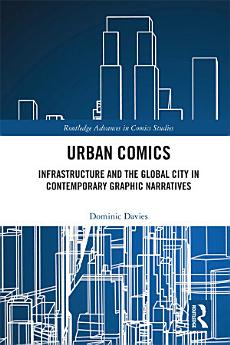
Urban Comics: Infrastructure and the Global City in Contemporary Graphic Narratives
About this ebook
Throughout, the author reads an expansive range of graphic narratives through the vocabulary of urban studies to argue that these formal innovations should be thought of as a kind of infrastructure. This ‘infrastructural form’ allows urban comics to reveal that the built environments of our cities are not static, banal, or depoliticised, but rather highly charged material spaces that allow some forms of social life to exist while also prohibiting others. Built from a formal infrastructure of grids, gutters and panels, and capable of volumetric, multi-scalar perspectives, this book shows how urban comics are able to represent, repair and even rebuild contemporary global cities toward more socially just and sustainable ends.
Operating at the intersection of comics studies and urban studies, and offering large global surveys alongside close textual and visual analyses, this book explores and opens up the fascinating relationship between comics and graphic narratives, on the one hand, and cities and urban spaces, on the other.
Discover more
About the author
Dominic Davies is a Lecturer in English at City, University of London. In 2018 he finished a British Academy Postdoctoral Fellowship at the University of Oxford, where he also completed his DPhil and established the TORCH Network, ‘Comics and Graphic Novels: The Politics of Form’. He is the author of Imperial Infrastructure and Spatial Resistance in Colonial Literature, 1880-1930 (2017), along with a number of articles and book chapters exploring the relationship between urban infrastructure, the built environment and artistic and literary cultures. He is the co-editor of Fighting Words: Fifteen Books that Shaped the Postcolonial World (2017) and Planned Violence: Post/Colonial Urban Infrastructure, Literature & Culture (2018). He is also the editor of a collection of essays and comics entitled Documenting Trauma in Comics: Traumatic Pasts, Embodied Histories & Graphic Reportage (2019).