About this ebook
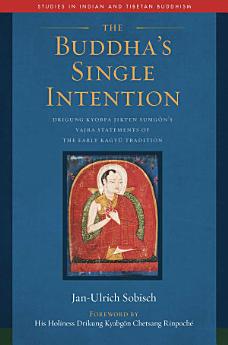
The definitive presentation of one of the most unique and compelling works of classical Tibetan literature.
This book presents an influential and extraordinary teaching of the Kagyü tradition of Tibetan Buddhism known as the Single Intention by the master Drigung Jikten Sumgön (1143–1217), along with its chief commentaries, principally the Light of the Sun by Rikzin Chökyi Drakpa (1595–1659).
Early in the history of the Kagyü school, the teachings of Jikten Sumgön were condensed into 150 core formulations called vajra statements. These pithy, revelatory statements comprise the Single Intention (Dgongs gcig), which presents the thought of the Buddha and the nature of the ineffable (brjod du med pa) in concise and direct expression. The Single Intention weaves the thread of ineffable mahamudra through the entire fabric of Buddhism. It presents mahamudra as pervading disciplined conduct, meditative concentration, and discriminative knowledge; ground, path, and result; view, practice, and conduct; and the “three vows” of pratimoksa, of the bodhisattvas, and of mantra. Jikten Sumgön teaches how the fundamental values and insights revealed by the Buddha are woven into reality and therefore accessible to all.
Jan-Ulrich Sobisch manages to convey the unity of the Buddha’s message both in its particulars and in its scope. His deep and authoritative skill makes this the definitive presentation of one of the most unique and compelling works of classical Tibetan literature.
The definitive presentation of one of the most unique and compelling works of classical Tibetan literature.
This book presents an influential and extraordinary teaching of the Kagyü tradition of Tibetan Buddhism known as the Single Intention by the master Drigung Jikten Sumgön (1143–1217), along...
Discover more
About the author
Jan-Ulrich Sobisch is on the faculty of the Center for Religious Studies at Ruhr-Universität Bochum. He studied Tibetology, Indology, and philosophy at Hamburg University from 1985 to 1992 with David Seyfort Ruegg, Lambert Schmithausen, and David Jackson, under whom he completed his dissertation on the three-vows literature. From 1994 to 1999, he was working under Albrecht Wezler for the Nepal-German Manuscript Preservation Project when he discovered and cataloged the complete thirty volumes of the writings of Amé Shab (1597–1659). From 2000 to 2016, he was a professor at the University of Copenhagen, during which time he published on the Hevajra Tantra and its associated Tibetan teachings in the Sakya school. For the past ten years, he has been focused on the unique Dgongs gcig tradition of the Drigung Kagyü school. In 2016 he received the prestigious Humboldt Research Award in recognition of his scholarly achievements.
Jan-Ulrich Sobisch is on the faculty of the Center for Religious Studies at Ruhr-Universität Bochum. He studied Tibetology, Indology, and philosophy at Hamburg University from 1985 to 1992 with David Seyfort Ruegg, Lambert Schmithausen, and David Jackson, under whom he completed his dissertation ...
Rate this ebook
Tell us what you think.
Reading information
Smartphones and tablets
Install the Google Play Books app for Android and iPad/iPhone. It syncs automatically with your account and allows you to read online or offline wherever you are.
Laptops and computers
You can listen to audiobooks purchased on Google Play using your computer's web browser.
eReaders and other devices
To read on e-ink devices like Kobo eReaders, you'll need to download a file and transfer it to your device. Follow the detailed Help Center instructions to transfer the files to supported eReaders.