About this ebook
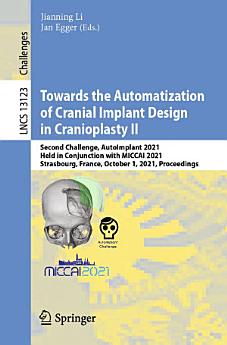
This book constitutes the Second Automatization of Cranial Implant Design in Cranioplasty Challenge, AutoImplant 2021, which was held in conjunction with the 24th International Conference on Medical Image Computing and Computer-Assisted Intervention, MICCAI 2021, in Strasbourg, France, in September, 2021. The challenge took place virtually due to the COVID-19 pandemic.
The 7 papers are presented together with one invited paper, one qualitative evaluation criteria from neurosurgeons and a dataset descriptor. This challenge aims to provide more affordable, faster, and more patient-friendly solutions to the design and manufacturing of medical implants, including cranial implants, which is needed in order to repair a defective skull from a brain tumor surgery or trauma. The presented solutions can serve as a good benchmark for future publications regarding 3D volumetric shape learning and cranial implant design.
This book constitutes the Second Automatization of Cranial Implant Design in Cranioplasty Challenge, AutoImplant 2021, which was held in conjunction with the 24th International Conference on Medical Image Computing and Computer-Assisted Intervention, MICCAI 2021, in Strasbourg, France, in Septemb...
Discover more
Rate this ebook
Tell us what you think.
Reading information
Smartphones and tablets
Install the Google Play Books app for Android and iPad/iPhone. It syncs automatically with your account and allows you to read online or offline wherever you are.
Laptops and computers
You can listen to audiobooks purchased on Google Play using your computer's web browser.
eReaders and other devices
To read on e-ink devices like Kobo eReaders, you'll need to download a file and transfer it to your device. Follow the detailed Help Center instructions to transfer the files to supported eReaders.