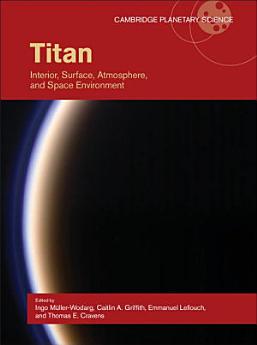
Titan: Interior, Surface, Atmosphere, and Space Environment

· · ·
· Cambridge Planetary Science Book 14 · Cambridge University Press
Ebook
479
Pages

About this ebook

Titan, the largest of Saturn's moons, shares remarkable similarities with Earth. Its thick atmosphere is composed primarily of nitrogen; it features the most complex organic chemistry known outside of Earth and, uniquely, hosts an analog to Earth's hydrological cycle, with methane forming clouds, rain and seas. Using the latest data from the ongoing Cassini–Huygens missions, laboratory measurements and numerical simulations, this comprehensive reference examines the physical processes that shape Titan's fascinating atmospheric structure and chemistry, weather, climate, circulation and surface geology. The text also surveys leading theories about Titan's origin and evolution, and assesses their implications for understanding the formation of other complex planetary bodies. Written by an international team of specialists, chapters offer detailed, comparative treatments of Titan's known properties and discuss the latest frontiers in the Cassini–Huygens mission, offering students and researchers of planetary science, geology, astronomy and space physics an insightful reference and guide.
Titan, the largest of Saturn's moons, shares remarkable similarities with Earth. Its thick atmosphere is composed primarily of nitrogen; it features the most complex organic chemistry known outside of Earth and, uniquely, hosts an analog to Earth's hydrological cycle, with methane forming clouds,...

Discover more

About the author

Ingo Mller-Wodarg is Reader in Planetary Science at Imperial College London. A specialist in the atmospheres of planets, moons and smaller objects in our Solar System, he has authored or co-authored more than 50 peer-reviewed scientific papers, including 22 on Titan. He is a team member of the Cassini Ion Neutral Mass Spectrometer, Team Leader for the Venus Express Atmospheric Drag Experiment, and plays key roles in designing forthcoming space missions, including the Jupiter Icy Moon Explorer mission. In 2002, he was awarded a Royal Society University Research Fellowship.

Caitlin Griffith is Professor of Planetary Sciences at the University of Arizona, where she investigates the atmospheres of planets, moons and exoplanets. She has authored or co-authored 80 peer-reviewed scientific papers, many of which concern Titan. In 1995, she was awarded the National Science Foundation Young Investigator Award. More recently she has served on the NRC Decadal Study and NASA's Planetary Science Subcommittee, which sets scientific priorities for future American space missions. She is currently helping to design two spacecraft missions to study Titan's organic lakes and the atmospheres of exoplanets.

Emmanuel Lellouch is an astronomer at the Observatoire de Paris. He has authored or co-authored nearly 200 peer-reviewed scientific papers, including 25 on Titan. He has been a member of instrument teams on several space missions, including the Cassini Composite Infrared Spectrometer and the Huygens Descent Imager/Spectral Radiometer. In 1995, he was awarded the Urey Prize of the Division of Planetary Sciences by the American Astronomical Society.

Tom Cravens is Professor of Physics and Astronomy at the University of Kansas. With more than 200 published papers, he has investigated the sources of X-rays throughout the Solar System as well as the upper atmospheres and ionospheres of most Solar System planets and satellites, including Titan. A fellow of the American Geophysical Union, he is a team member of the Cassini Ion and Neutral Mass Spectrometer and author of the Cambridge University Press textbook Physics of Solar System Plasmas (1997).
Ingo Mller-Wodarg is Reader in Planetary Science at Imperial College London. A specialist in the atmospheres of planets, moons and smaller objects in our Solar System, he has authored or co-authored more than 50 peer-reviewed scientific papers, including 22 on Titan. He is a team member of the Ca...

Rate this ebook

Tell us what you think.

Reading information

Smartphones and tablets
Install the Google Play Books app for Android and iPad/iPhone. It syncs automatically with your account and allows you to read online or offline wherever you are.
Laptops and computers
You can listen to audiobooks purchased on Google Play using your computer's web browser.
eReaders and other devices
To read on e-ink devices like Kobo eReaders, you'll need to download a file and transfer it to your device. Follow the detailed Help Center instructions to transfer the files to supported eReaders.