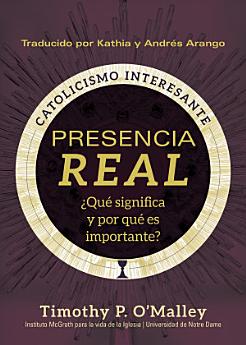
Presencia real: ¿Qué significa y por qué es importante?
About this ebook
Si no estás seguro de cómo responder a estas preguntas sobre este misterio central de nuestra fe, no estás solo; la mayoría de los católicos no saben cómo responder. En Presencia real, el teólogo de la Universidad de Notre Dame, Timothy P. O'Malley, aclara la confusión al explicar los orígenes bíblicos y la larga tradición de las doctrinas de la Iglesia sobre la presencia real y la transubstanciación. También explora las prácticas espirituales necesarias para formarnos para reconocer a Cristo en la Eucaristía y ver al Señor en los demás.
Aprenderás:
- cómo la doctrina de la presencia real tiene sus raíces en la revelación divina y cómo la enseñanza de la Iglesia sobre la transubstanciación es espiritualmente fructífera para los creyentes de hoy;
- cómo adorar a Cristo en la Eucaristía y hacer un verdadero asentimiento a la presencia real;
- cómo la Eucaristía es crucial para hacer crecer nuestra capacidad de reconocer a Cristo en la Palabra y en los demás; y
- la importante relación entre la comunión eucarística y la adoración.
Discover more
About the author
Timothy P. O’Malley is a Catholic theologian, author, and professor. He serves as the associate director for research at the McGrath Institute for Church Life at the University of Notre Dame and academic director of the Notre Dame Center for Liturgy. He regularly teaches both undergraduate and graduate courses in sacramental theology, marriage and family, catechesis, and spirituality.O’Malley earned his bachelor’s degree in theology and philosophy and his master’s degree in theology with a concentration in liturgical studies from the University of Notre Dame. He earned a doctorate in theology and education from Boston College, where he wrote on liturgical formation in the writings of Augustine of Hippo. O’Malley is the author of many books, including three award-winning books published by Ave Maria Press: Off the Hook: God, Love, Dating, and Marriage in a Hookup World; Real Presence: What Does It Mean and Why Does It Matter?; and Becoming Eucharistic People: The Hope and Promise of Parish Life. His most recent book, Behold, Believe, Become: Meeting the Hidden Christ in Things We See, Say, and Do at Mass, has also been well received. He has written for scholarly journals, the McGrath Institute for Church Life’s Church Life Journal, and popular magazines throughout the United States.O’Malley is the lead investigator on two grants from the Lilly Foundation: one related to preaching and the other to children and worship. These grants pertain to his interest in cultivating a contemplative and sacramental imagination in an age dominated by technology, spectacle, and polarization.He lives with his family in the South Bend, Indiana, area.
The McGrath Institute for Church Life was founded as the Center for Pastoral and Social Ministry by the late Notre Dame president Fr. Theodore Hesburgh, CSC, in 1976. The McGrath Institute partners with Catholic dioceses, parishes, and schools to provide theological education and formation to address pressing pastoral problems. The Institute connects the Catholic intellectual tradition to the pastoral life of the Church in forming faithful Catholic leaders for service to the Church and the world. The McGrath Institute strives to be the preeminent source of creative Catholic content and programming for the new evangelization in the United States.
Andrés Arango is the bishop's delegate for Hispanic ministry and director of evangelization in the Diocese of Camden, New Jersey. He has served in various ministries since 1995, including two terms as a consultant to the USCCB Subcommittee on Hispanic Affairs and chairman of the National Committee for the Catholic Charismatic Renewal in the United States and Canada. Originally from Colombia, he moved to the United States in 2001. Arango is the author of Renovación Carismática Católica.Arango is president of the Latin American Catholic Charismatic Council, in addition to being the coordinator of formation and representative of North America and the Caribbean of the International Service of the Catholic Charismatic Renewal. He has a master’s degree in theological studies from the Franciscan School of Theology.He and his wife, Kathia, are active lay ministers who teach and preach at retreats and conferences around the world. They live in New Jersey with their family.
John C. Cavadini is the McGrath-Cavadini Director of the Institute for Church Life at the University of Notre Dame. A member of Notre Dame’s department of theology, Cavadini served as chair of the department from 1997 to 2010, during which he led the department to a top-ten ranking in the National Research Council rankings of doctoral programs. He is an expert in patristic and early medieval theology, with a special focus on the theology of St. Augustine. In November 2009 he was appointed by Pope Benedict XVI to a five-year term on the International Theological Commission.