About this ebook
We've learned to name capital cities, rivers, and the bones of our bodies. But when something tightens our chest at three in the morning, we often can't tell if it's fear or sadness, anger or nostalgia. And a nameless emotion rules us from the darkness: it dictates the tone we use, the messages we don't send, the doors we slam.
A named emotion, however, changes state. From fog it becomes a room. A place with walls and a door: a place you can enter and from which—we always forget this — you can also exit.
Names are handles. They're used to open doors.
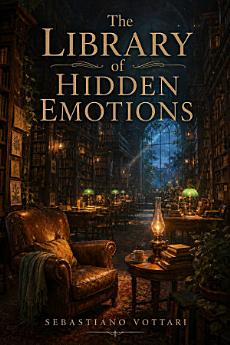
One evening, on a street you walk by heart, you find a door you'd swear was never there. On the plaque, a subtle inscription: "Library of hidden emotions. Open when needed ." Inside, a librarian who doesn't ask you what you're looking for. She asks how you are. And truly waits for an answer.
Here, the books aren't catalogued by author or genre, but by what they make you feel. Eleven rooms, eleven emotions:
The Room of Anger — anger as a boundary, not just as an explosion.
The shelf of Nostalgia — the sweet pain of things that don't add up.
The Archive of Fear — fear as guardian, not just as enemy.
The Table of Sadness — sitting with what weighs you down, without rushing to console.
The Joy Department — the joy that doesn't need to be justified.
The Corridor of Shame — when we think we're wrong.
The Waiting Room — everything that hasn't arrived yet.
The Garden of Hope — a small, but stubborn light.
The Case of Jealousy — the desire to be chosen.
The Silence of Solitude — being alone without feeling abandoned.
The Room of Love — not just loving someone, but learning to stay open.
Upon entering, you'll receive a blank notebook. Each room will leave a question to take away and a page to fill in. At the end, the notebook is returned.
THE THIRD VOLUME OF THE SERIES
After the book of stillness: The Shen Bible and the book of the body: The Shen Bible 2 , this is the book of words.
The first volume taught us to pause and return to our center. The second, to daily care for the body that inhabits that center. This third volume delivers what made the other two possible without us realizing it: the naming of emotions. Because no one can embrace an emotion they don't know how to name. Before release comes recognition.
But the pace changes here, and it's a choice. You won't find numbered exercises or protocols to tick off: some things are learned only by experiencing them, and experiencing them requires a story. This isn't a manual to be finished. It's a place to be frequented.
WHO IS THIS BOOK FOR?
1) For those who have encountered the Shen in the first two volumes and now want to give a name to the emotions that agitate him.
2) For those who feel a lot but say little. For those who answer "well" out of habit—the world's shortest lie. For those who love books that don't explain emotions, but rather make them live. For those seeking a path of personal growth that passes through literature rather than formulas.
You can walk down the main corridor, room after room, and discover how shame dwells just steps away from waiting, and loneliness borders on love. Or you can enter through the door you need today. The rooms won't be offended if you skip them: they know how to wait, that's their job.
Emotions can't be eliminated. They're listened to.
You always leave with more questions than you had. That's a sign the visit was successful.
The door is there. No need to knock.