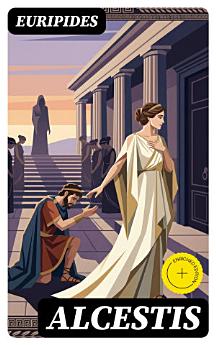
Alcestis (Annotated): Enriched Edition. An Ancient Greek Tragedy of Love, Sacrifice, Female Agency, and the Struggle Against Mortality and Fate
Sep 2022 · DigiCat
Ebook
46
Pages
family_home
Eligible
info
About this ebook
Euripides' *Alcestis*, first performed in 438 BCE, is a formally elusive drama that combines tragic pathos with elements of satyr play, comic relief, and folktale romance. Its central premise is stark: Alcestis agrees to die in place of her husband, Admetus, only to be restored from death through Heracles' intervention. Yet the play's interest lies less in miraculous resolution than in its ethical ambiguities—whether Admetus deserves such devotion, whether Alcestis's sacrifice is truly voluntary, and how grief reshapes familial and social bonds. Through psychologically acute dialogue, tonal shifts, and a strikingly present but silent heroine, Euripides tests conventional ideals of marital loyalty, heroic obligation, and reciprocity within the mythic and civic world of classical Athens. Euripides (c. 480–406 BCE), one of Athens' three canonical tragedians, was renowned in antiquity for challenging inherited myths and exposing the tensions beneath heroic values. His dramatic innovations—especially his interest in marginalized voices, domestic experience, and morally compromised characters—help explain the play's unusual focus on a woman whose action determines the fate of an entire household. Written during a period when Athenian tragedy was expanding beyond monumental legend into ethical and emotional inquiry, *Alcestis* reflects the playwright's characteristic skepticism toward easy moral judgments while remaining attentive to ritual, gender, and civic expectations. This is an especially rewarding work for readers interested in Greek tragedy, gender studies, ethics, and the evolution of tragic form. Its blend of solemnity and comedy makes it an accessible entry into Euripidean drama, while its unresolved questions invite sustained scholarly interpretation. Readers will find in *Alcestis* not merely a tale of noble sacrifice, but a sophisticated meditation on love, obligation, mortality, and the costs of survival. This enriched edition has been carefully crafted to add value to your reading experience. - A succinct Introduction situates the work's timeless appeal and themes. - The Synopsis outlines the central plot, highlighting key developments without spoiling critical twists. - A detailed Historical Context immerses you in the era's events and influences that shaped the writing. - An Author Biography reveals milestones in the author's life, illuminating the personal insights behind the text. - A thorough Analysis dissects symbols, motifs, and character arcs to unearth underlying meanings. - Reflection questions prompt you to engage personally with the work's messages, connecting them to modern life. - Hand‐picked Memorable Quotes shine a spotlight on moments of literary brilliance. - Interactive footnotes clarify unusual references, historical allusions, and archaic phrases for an effortless, more informed read.
Euripides' *Alcestis*, first performed in 438 BCE, is a formally elusive drama that combines tragic pathos with elements of satyr play, comic relief, and folktale romance. Its central premise is stark: Alcestis agrees to die in place of her husband, Admetus, only to be restored from death through...
Discover more
About the author
Euripides (circa 480 – 406 BCE) remains one of the cannonical figures of classical Athenian drama. Alongside Aeschylus and Sophocles, he forms a trio who revolutionized dramatic composition and performance. Euripides is noted for his exploration of human psychology and his dramatic innovations, particularly his sympathetic portrayal of female protagonists and his use of subversive narrative structures. 'Alcestis', one of his extant plays, exemplifies these qualities and is remarkable for its tragic and comic elements interwoven to relate the myth of Alcestis, who sacrifices her life in place of her husband, Admetus, and is later rescued by Heracles. With over 90 plays attributed to him (though only 18 have survived in complete form), Euripides' work constitutes a major portion of what is known of ancient Greek theatre. His plays were highly intellectual and often challenged the social and political norms of his day, distinguishing his literary style as both avant-garde and provocative. 'Alcestis', in particular, has been celebrated for its looming question of the nature of self-sacrifice and marital devotion. Euripides' influence endures in the Western literary canon; his narratives and themes are still potent and widely studied for their rich emotional tapestry and complex characterization.
Euripides (circa 480 – 406 BCE) remains one of the cannonical figures of classical Athenian drama. Alongside Aeschylus and Sophocles, he forms a trio who revolutionized dramatic composition and performance. Euripides is noted for his exploration of human psychology and his dramatic innovations, p...
Rate this ebook
Tell us what you think.
Reading information
Smartphones and tablets
Install the Google Play Books app for Android and iPad/iPhone. It syncs automatically with your account and allows you to read online or offline wherever you are.
Laptops and computers
You can listen to audiobooks purchased on Google Play using your computer's web browser.
eReaders and other devices
To read on e-ink devices like Kobo eReaders, you'll need to download a file and transfer it to your device. Follow the detailed Help Center instructions to transfer the files to supported eReaders.