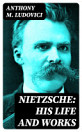
Ecce Homo: How One Becomes What One Is Nietzsche’s Autobiography — Annotated & Illustrated Edition
About this ebook
Far from a conventional memoir, Ecce Homo explores what it means to become oneself—to live deliberately, think independently, and reject inherited values that weaken rather than strengthen the individual. With famously provocative chapter titles such as “Why I Am So Wise” and “Why I Write Such Excellent Books,” Nietzsche challenges readers to move beyond moral comfort, conformity, and passive thinking.
This Annotated & Illustrated Edition by Open Book House Publishing & Solutions has been carefully prepared for modern readers. Alongside the original text, this edition includes:
A clear, modern introduction explaining why Ecce Homo still matters today
Contextual notes that clarify Nietzsche’s ideas, references, and tone
Explanations of key concepts such as the Übermensch, Will to Power, Eternal Recurrence, and self-creation
A concise intellectual timeline linking Nietzsche’s life to his major works
Original black-and-white illustrations in a classic engraving style, enhancing reflection without distracting from the text
This edition is designed not to tell readers what to think, but to help them read Nietzsche accurately and critically, free from common misinterpretations and ideological misuse.
Challenging, unsettling, and deeply reflective, Ecce Homo remains one of the most important works for readers interested in philosophy, psychology, identity, and the courage required to live consciously.
Discover more
About the author
Friedrich Wilhelm Nietzsche (1844–1900) was a German philosopher, cultural critic, and classical philologist whose ideas have had a profound and lasting impact on modern thought. Born in Röcken, Prussia, into a Lutheran family, Nietzsche received a rigorous classical education and showed exceptional academic promise from an early age.
At just twenty-four, he was appointed Professor of Classical Philology at the University of Basel—an extraordinary achievement that marked the beginning of his intellectual career. However, persistent health problems forced him to resign after a decade, leading him into a life of solitude and independent scholarship. It was during this period that he produced his most influential works.
Nietzsche’s philosophy is characterized by a deep critique of traditional morality, religion, and cultural conformity. He questioned accepted notions of truth and challenged systems that, in his view, weakened human vitality and creativity. Rather than constructing a formal philosophical system, Nietzsche wrote in a distinctive style that combines aphorism, analysis, and poetic intensity.
Among his major works are The Birth of Tragedy, Thus Spoke Zarathustra, Beyond Good and Evil, On the Genealogy of Morals, and Ecce Homo. In these writings, he explored themes such as self-creation, the origins of moral values, the Will to Power, and the role of the individual in shaping meaning and purpose.
Nietzsche suffered a mental collapse in 1889 and spent the remaining years of his life in silence, cared for by his family. Although his work was not widely recognized during his lifetime, it gained significant influence in the twentieth century, shaping fields such as philosophy, psychology, literature, and cultural criticism.
Today, Nietzsche is regarded as one of the most important thinkers of modern philosophy. His work continues to challenge readers to question inherited beliefs, think independently, and confront the deeper foundations of human values.
Anthony M. Ludovici (1882–1971) was a British philosopher, social critic, and translator, best known for his influential role in introducing the works of Friedrich Wilhelm Nietzsche to English-speaking audiences.
Ludovici was one of the early twentieth century’s most prominent interpreters of Nietzsche. He contributed extensively to the English editions of Nietzsche’s works, particularly through his association with the editorial projects led by Oscar Levy. His translations and commentaries helped shape the initial reception of Nietzsche’s philosophy in Britain and beyond.
In addition to translation, Ludovici was a prolific writer in his own right, producing works on philosophy, culture, politics, and social issues. His writing reflects a strong engagement with Nietzschean ideas, especially in areas such as morality, individualism, and the critique of modern society.
As a translator, Ludovici aimed to preserve the intensity and precision of Nietzsche’s original German prose. His work reflects the scholarly standards of his time, often favoring formal and literal phrasing over simplification. While the language may appear dated to modern readers, his translations remain valuable for their fidelity and historical importance.
Ludovici’s contributions played a significant role in establishing Nietzsche as a major philosophical figure in the English-speaking world. His translations continue to be used in public-domain editions and provide an important foundation for modern annotated and contextualized interpretations.
Paul V. Cohn was an early twentieth-century scholar and translator associated with the first major English editions of Friedrich Wilhelm Nietzsche’s works. His contributions formed part of the influential translation projects that introduced Nietzsche’s philosophy to a wider English-speaking audience.
Working during a period when Nietzsche was still relatively unknown outside continental Europe, Cohn helped make complex philosophical ideas accessible through careful and disciplined translation. His work reflects the scholarly approach of his time, emphasizing accuracy and structural fidelity to the original German text rather than stylistic simplification.
Cohn’s translations are characterized by a formal tone and close adherence to Nietzsche’s phrasing, preserving the intensity and precision of the original arguments. While the language may feel somewhat traditional to modern readers, it remains reliable and suitable for serious study, particularly when supported by editorial notes and annotations.
As part of early twentieth-century Nietzsche scholarship, Paul V. Cohn’s work holds historical importance. His translations continue to serve as a foundation for public-domain editions and provide valuable material for annotated and modernized presentations of Nietzsche’s thought.