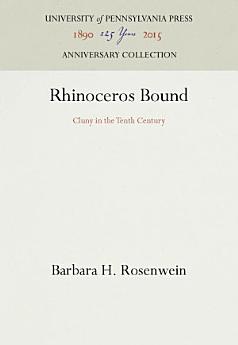
Rhinoceros Bound: Cluny in the Tenth Century
Nov 2016 · University of Pennsylvania Press
Ebook
192
Pages
family_home
Eligible
info
About this ebook
"The rhinoceros, that is, any powerful man, is bound with a thong so that he may crush the clods of the valleys, that is, the oppressors of the humble."—Odo of Cluny, Vita Geraldi i.8
To the second abbot of the great monastery at Cluny, Saint Odo, tenth-century Europe was a world filled with violent men oppressing at whim the poor and the powerless. As royal authority waned, local magnates, unrestrained by any authority, divine or human, seized the opportunity to enhance their positions. Odo, along with Cluny's other founding spiritual and ideological leaders, created within the protective walls of the monastery a model of restraint, instituting in place of the instability of everyday life an interpretation of the Benedictine Rule that stressed ritual, order, and lawfulness. Such were the beginnings of the monastery that Pope Urban II in the eleventh century would call "the light of the world," the fountainhead of what would become one of the most far-reaching religious reform movements in European history.
Barbara Rosenwein in Rhinoceros Bound focuses on Cluny's founding and early growth within the context of a society shaped by the needs of those set adrift in the social upheaval of the tenth century. Examining in the first chapter traditional approaches to Cluniac studies, the author reveals that historians have generally considered Cluny's eleventh-century role in church reform without analyzing the peculiar combination of forces and founders that created the Cluniac ideal and gave it its original momentum. This fundamental problem is the topic of the second chapter. She then examines how the early Cluniacs perceived the world outside the monastery and how they viewed their own world inside of it.
Rosenwein concludes with a chapter on Cluny in the tenth century that combines traditional historical techniques with contemporary sociological insights. She provides in this study a significant reassessment of a period crucial to the political development of Europe, as well as a case study of institutional response to acute and political change.
"The rhinoceros, that is, any powerful man, is bound with a thong so that he may crush the clods of the valleys, that is, the oppressors of the humble."—Odo of Cluny, Vita Geraldi i.8
To the second abbot of the great monastery at Cluny, Saint Odo, tenth-century Europe was a world filled with vio...
Discover more
About the author
Barbara H. Rosenwein is Professor Emerita of History at Loyola University Chicago.
Barbara H. Rosenwein is Professor Emerita of History at Loyola University Chicago.
Rate this ebook
Tell us what you think.
Reading information
Smartphones and tablets
Install the Google Play Books app for Android and iPad/iPhone. It syncs automatically with your account and allows you to read online or offline wherever you are.
Laptops and computers
You can listen to audiobooks purchased on Google Play using your computer's web browser.
eReaders and other devices
To read on e-ink devices like Kobo eReaders, you'll need to download a file and transfer it to your device. Follow the detailed Help Center instructions to transfer the files to supported eReaders.