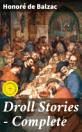
Bureaucracy
Sep 2022 · DigiCat
Ebook
194
Pages
family_home
Eligible
info
About this ebook
In "Bureaucracy," Honoré de Balzac delves into the intricate web of administrative life in 19th-century France, illuminating the often maddening operations and pervasive inefficiencies of government institutions. Written in his signature realist style, Balzac employs sharp observations and a rich tableau of characters to portray the labyrinthine complexities of bureaucracy. The narrative unfolds through a series of vignettes, reflecting the author's keen insight into the interplay between power, politics, and the individual, showcasing how the fabric of society is woven through often-absurd bureaucratic machinations. Balzac, a critical observer of his era, drew extensively from his own experiences with the bureaucratic systems of France, which provided fertile ground for his exploration of power and identity. His extensive literary oeuvre, particularly the series "La Comédie Humaine," reveals a deep concern for the socio-economic realities of his time, signaling how the bureaucratic mechanisms not only shaped individual destinies but also reflected broader societal trends. "Bureaucracy" stands as a vital read for anyone seeking to understand the dynamics of power and the human condition within institutional frameworks. Balzac's keen analysis resonates even in contemporary contexts, making this work a compelling invitation to reflect on the implications of bureaucracy in our own lives.
In "Bureaucracy," Honoré de Balzac delves into the intricate web of administrative life in 19th-century France, illuminating the often maddening operations and pervasive inefficiencies of government institutions. Written in his signature realist style, Balzac employs sharp observations and a rich...
About the author
Honoré de Balzac (1799–1850) was a French novelist and playwright, whose work had a profound influence on the Realist movement in literature. He is best known for 'La Comédie humaine', a series of novels and stories depicting French society in the post-Napoleonic era. Not merely a writer but a keen social observer, Balzac's extensive output can be seen as an encyclopedia of French society. His works delve into a variety of aspects such as power, ambition, social stratification, and the role of money, exposing the inner workings of humanity with psychological depth and detail. One of his works, 'Bureaucracy,' is a satirical look at the French governmental departments and civil service, which consists of a detailed hierarchical system that often neglects the very citizens it is meant to serve. In this book, as in many others, Balzac's intricate portrayal of characters and the social setting reflects his iconic narrative style, which combines keen analysis with vivid description. His influences extend far beyond the literary realm; Marcel Proust, Charles Dickens, and even Karl Marx regarded him highly for his contributions to literature and social thought. Balzac's legacy is enshrined in his keen capacity to encapsulate the spirit of an age, earning him a permanent place among the pantheon of literary giants.
Honoré de Balzac (1799–1850) was a French novelist and playwright, whose work had a profound influence on the Realist movement in literature. He is best known for 'La Comédie humaine', a series of novels and stories depicting French society in the post-Napoleonic era. Not merely a writer but a ke...
Rate this ebook
Tell us what you think.
Reading information
Smartphones and tablets
Install the Google Play Books app for Android and iPad/iPhone. It syncs automatically with your account and allows you to read online or offline wherever you are.
Laptops and computers
You can listen to audiobooks purchased on Google Play using your computer's web browser.
eReaders and other devices
To read on e-ink devices like Kobo eReaders, you'll need to download a file and transfer it to your device. Follow the detailed Help Center instructions to transfer the files to supported eReaders.