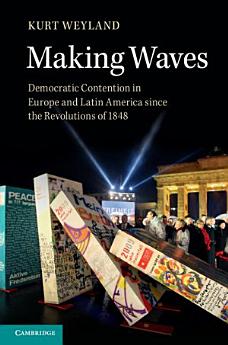
Making Waves: Democratic Contention in Europe and Latin America since the Revolutions of 1848

· Cambridge University Press
Ebook
329
Pages

About this ebook

This study investigates the three main waves of political regime contention in Europe and Latin America. Surprisingly, protest against authoritarian rule spread across countries more quickly in the nineteenth century, yet achieved greater success in bringing democracy in the twentieth. To explain these divergent trends, the book draws on cognitive-psychological insights about the inferential heuristics that people commonly apply; these shortcuts shape learning from foreign precedents such as an autocrat's overthrow elsewhere. But these shortcuts had different force, depending on the political-organizational context. In the inchoate societies of the nineteenth century, common people were easily swayed by these heuristics: jumping to the conclusion that they could replicate such a foreign precedent in their own countries, they precipitously challenged powerful rulers, yet often at inopportune moments - and with low success. By the twentieth century, however, political organizations had formed. As organizational ties loosened the bounds of rationality, contentious waves came to spread less rapidly, but with greater success.
This study investigates the three main waves of political regime contention in Europe and Latin America. Surprisingly, protest against authoritarian rule spread across countries more quickly in the nineteenth century, yet achieved greater success in bringing democracy in the twentieth. To explain...

Discover more

About the author

Kurt Weyland is the Lozano Long Professor of Latin American Politics and professor of government at the University of Texas, Austin. He received his PhD in political science at Stanford University in 1991. Based on intensive field research in Argentina, Bolivia, Brazil, Chile, Costa Rica, Peru and Venezuela, he has written three books and numerous journal articles on democracy, economic and social policy, populism, and diffusion processes in Latin America. Many of his articles and books have drawn on cognitive-psychological insights about bounded rationality to shed new light on puzzling political phenomena, such as the adoption of risky reforms in fragile democracies and the rash, ill-considered emulation of foreign precedents and models in a wide range of countries.

Kurt Weyland is the Lozano Long Professor of Latin American Politics and professor of government at the University of Texas, Austin. He received his PhD in political science at Stanford University in 1991. Based on intensive field research in Argentina, Bolivia, Brazil, Chile, Costa Rica, Peru an...

Rate this ebook

Tell us what you think.

Reading information

Smartphones and tablets
Install the Google Play Books app for Android and iPad/iPhone. It syncs automatically with your account and allows you to read online or offline wherever you are.
Laptops and computers
You can listen to audiobooks purchased on Google Play using your computer's web browser.
eReaders and other devices
To read on e-ink devices like Kobo eReaders, you'll need to download a file and transfer it to your device. Follow the detailed Help Center instructions to transfer the files to supported eReaders.