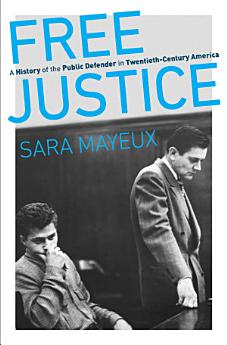
Free Justice: A History of the Public Defender in Twentieth-Century America
Sara Mayeux
Apr 2020 · UNC Press Books
Ebook
286
Pages
Tools
info
About this ebook
Every day, in courtrooms around the United States, thousands of criminal defendants are represented by public defenders — lawyers provided by the government for those who cannot afford private counsel. Though often taken for granted, the modern American public defender has a surprisingly contentious history — one that offers insights not only about the “carceral state,” but also about the contours and compromises of twentieth-century liberalism.
First gaining appeal amidst the Progressive Era fervor for court reform, the public defender idea was swiftly quashed by elite corporate lawyers who believed the legal profession should remain independent from the state. Public defenders took hold in some localities but not yet as a nationwide standard. By the 1960s, views had shifted. Gideon v. Wainwright enshrined the right to counsel into law and the legal profession mobilized to expand the ranks of public defenders nationwide. Yet within a few years, lawyers had already diagnosed a “crisis” of underfunded, overworked defenders providing inadequate representation — a crisis that persists today. This book shows how these conditions, often attributed to recent fiscal emergencies, have deep roots, and it chronicles the intertwined histories of constitutional doctrine, big philanthropy, professional in-fighting, and Cold War culture that made public defenders ubiquitous but embattled figures in American courtrooms.
First gaining appeal amidst the Progressive Era fervor for court reform, the public defender idea was swiftly quashed by elite corporate lawyers who believed the legal profession should remain independent from the state. Public defenders took hold in some localities but not yet as a nationwide standard. By the 1960s, views had shifted. Gideon v. Wainwright enshrined the right to counsel into law and the legal profession mobilized to expand the ranks of public defenders nationwide. Yet within a few years, lawyers had already diagnosed a “crisis” of underfunded, overworked defenders providing inadequate representation — a crisis that persists today. This book shows how these conditions, often attributed to recent fiscal emergencies, have deep roots, and it chronicles the intertwined histories of constitutional doctrine, big philanthropy, professional in-fighting, and Cold War culture that made public defenders ubiquitous but embattled figures in American courtrooms.
Every day, in courtrooms around the United States, thousands of criminal defendants are represented by public defenders — lawyers provided by the government for those who cannot afford private counsel. Though often taken for granted, the modern American public defender has a surprisingly contenti...
Discover more
About the author
Sara Mayeux is associate professor of law at Vanderbilt University.
Sara Mayeux is associate professor of law at Vanderbilt University.
Rate this ebook
Tell us what you think.
Reading information
Smartphones and tablets
Install the Google Play Books app for Android and iPad/iPhone. It syncs automatically with your account and allows you to read online or offline wherever you are.
Laptops and computers
You can listen to audiobooks purchased on Google Play using your computer's web browser.
eReaders and other devices
To read on e-ink devices like Kobo eReaders, you'll need to download a file and transfer it to your device. Follow the detailed Help Center instructions to transfer the files to supported eReaders.