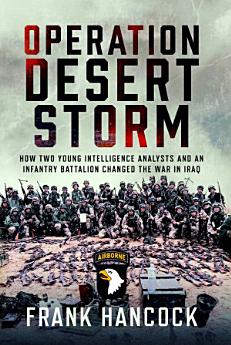
Operation Desert Storm: How Two Young Intelligence Analysts and an Infantry Battalion Changed the War in Iraq
Frank Hancock
Nov 2025 · Pen and Sword Military
Ebook
256
Pages
family_home
Eligible
info
About this ebook
“During Desert Storm the Air Force and the Armor forces were the thunder but the 101st was the lightning.” General Norman Schwarzkopf, April, 1991. Camp Eagle II, Saudi Arabia Operation Desert Storm chronicles perhaps the most incredible story of the Gulf War that has never been told. It describes two young soldiers from the intelligence section of 1-327 Infantry, 101st Airborne Division, Captain Jose Delgado and Sergeant Jesus Gonzalez, who unlocked an intelligence puzzle none of their higher headquarters recognized. This pivotal discovery occurred after the finalization of the 101st Airborne’s plans for attacking into Iraq and altered the direction of Desert Storm. 1-327 Infantry was also the lead unit of what became the largest air assault (by helicopter) in US history. The 101st Airborne was a unique army division because of the 300+ helicopters in its arsenal. General Schwarzkopf's "Hail Mary" plan, to use the 101st to air assault deep into Iraq and cut the Euphrates Valley, was the boldest operational maneuver for the US Military since the Inchon landing in Korea in 1950. Schwarzkopf's plan stretched the division’s capabilities to their limits and demonstrated the 101st Airborne’s strengths and weaknesses. CPT Jose Delgado and SGT Jesus Gonzalez discovered the fatal intelligence flaw, an enemy battalion’s bunker-trench complex in 1-327 Infantry’s lead company's landing zone. Their discovery, 48 hours before the air assault, caused the division's plan to be altered, although it was a significant challenge to do so. Without their discovery, the attack was destined for disaster. In writing the book, Colonel Frank Hancock, Battalion Commander of 1-327 Infantry, asked soldiers from across the battalion to provide narratives and their recollections of what happened, thereby providing a full view of what occurred and why, from the perspective of soldiers ranging in rank from private to colonel. The book also details the process of how the US Army learned from its experiences in Vietnam, made changes, and became a different, structured, and more lethal army in the post-Vietnam era.
“During Desert Storm the Air Force and the Armor forces were the thunder but the 101st was the lightning.” General Norman Schwarzkopf, April, 1991. Camp Eagle II, Saudi Arabia Operation Desert Storm chronicles perhaps the most incredible story of the Gulf War that has never been told. It describe...
Discover more
About the author
Colonel (Ret) Frank Hancock was the Battalion Commander of 1-327 Infantry, a 700-man battalion in the 101st Airborne Division (Air Assault) during Operation Desert Shield/Desert Storm (1990/91). In 1993, after finishing his battalion command with the 101st Airborne, he published a Strategic Research Paper as a student at the US Army War College. Titled “North to The Euphrates, Part One: The Taking of FOB Cobra,” this report provides much of the operational framework of the unit’s mission in the Gulf War and the all-important first day of the ground attack into Iraq. The basis for his research paper is also the operational basis for the book and provides the source document thirty years later.
Colonel (Ret) Frank Hancock was the Battalion Commander of 1-327 Infantry, a 700-man battalion in the 101st Airborne Division (Air Assault) during Operation Desert Shield/Desert Storm (1990/91). In 1993, after finishing his battalion command with the 101st Airborne, he published a Strategic Resea...
Rate this ebook
Tell us what you think.
Reading information
Smartphones and tablets
Install the Google Play Books app for Android and iPad/iPhone. It syncs automatically with your account and allows you to read online or offline wherever you are.
Laptops and computers
You can listen to audiobooks purchased on Google Play using your computer's web browser.
eReaders and other devices
To read on e-ink devices like Kobo eReaders, you'll need to download a file and transfer it to your device. Follow the detailed Help Center instructions to transfer the files to supported eReaders.