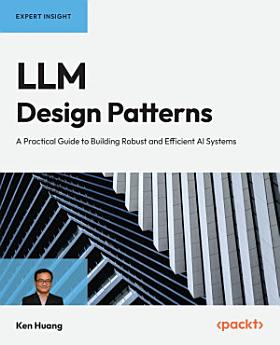
LLM Design Patterns: A Practical Guide to Building Robust and Efficient AI Systems

· Packt Publishing Ltd
1 review
Ebook
538
Pages
Tools

About this ebook

Explore reusable design patterns, including data-centric approaches, model development, model fine-tuning, and RAG for LLM application development and advanced prompting techniques Free with your book: PDF Copy, AI Assistant, and Next-Gen ReaderKey Features
  • Learn comprehensive LLM development, including data prep, training pipelines, and optimization
  • Explore advanced prompting techniques, such as chain-of-thought, tree-of-thought, RAG, and AI agents
  • Implement evaluation metrics, interpretability, and bias detection for fair, reliable models
Book DescriptionThis practical guide for AI professionals enables you to build on the power of design patterns to develop robust, scalable, and efficient large language models (LLMs). Written by a global AI expert and popular author driving standards and innovation in Generative AI, security, and strategy, this book covers the end-to-end lifecycle of LLM development and introduces reusable architectural and engineering solutions to common challenges in data handling, model training, evaluation, and deployment. You’ll learn to clean, augment, and annotate large-scale datasets, architect modular training pipelines, and optimize models using hyperparameter tuning, pruning, and quantization. The chapters help you explore regularization, checkpointing, fine-tuning, and advanced prompting methods, such as reason-and-act, as well as implement reflection, multi-step reasoning, and tool use for intelligent task completion. The book also highlights Retrieval-Augmented Generation (RAG), graph-based retrieval, interpretability, fairness, and RLHF, culminating in the creation of agentic LLM systems. By the end of this book, you’ll be equipped with the knowledge and tools to build next-generation LLMs that are adaptable, efficient, safe, and aligned with human values. What you will learn
  • Implement efficient data prep techniques, including cleaning and augmentation
  • Design scalable training pipelines with tuning, regularization, and checkpointing
  • Optimize LLMs via pruning, quantization, and fine-tuning
  • Evaluate models with metrics, cross-validation, and interpretability
  • Understand fairness and detect bias in outputs
  • Develop RLHF strategies to build secure, agentic AI systems
Who this book is for

This book is essential for AI engineers, architects, data scientists, and software engineers responsible for developing and deploying AI systems powered by large language models. A basic understanding of machine learning concepts and experience in Python programming is a must.

Explore reusable design patterns, including data-centric approaches, model development, model fine-tuning, and RAG for LLM application development and advanced prompting techniques Free with your book: PDF Copy, AI Assistant, and Next-Gen ReaderKey Features Learn comprehensive LLM development, in...

Discover more

Ratings and reviews

1 review

About the author

Ken Huang is an acclaimed author of 8 books on AI and Web3. He is the Co-Chair of the AI Organizational Responsibility Working Group and AI Control Framework at the Cloud Security Alliance. In addition, Huang contributed extensively to key initiatives in the space. He is a core contributor to OWASP's Top 10 Risks for LLM Applications and heavily involved in the NIST Generative AI Public Working Group. He also provides feedback on publications like NIST SP 800-226. A sought-after speaker, Ken has shared his insights at renowned global conferences, including those hosted by Davos WEF, ACM, IEEE, and CSA AI Summit, CSA AI Think Tank Day and World Bank. His recent co-authorship of "Blockchain and Web3: Building the Cryptocurrency, Privacy, and Security Foundations of the Metaverse" adds to his reputation, with the book being recognized as one of the must-reads in both 2023 and 2024 by TechTarget.


Ken Huang is an acclaimed author of 8 books on AI and Web3. He is the Co-Chair of the AI Organizational Responsibility Working Group and AI Control Framework at the Cloud Security Alliance. In addition, Huang contributed extensively to key initiatives in the space. He is a core contributor to OWA...

Rate this ebook

Tell us what you think.

Reading information

Smartphones and tablets
Install the Google Play Books app for Android and iPad/iPhone. It syncs automatically with your account and allows you to read online or offline wherever you are.
Laptops and computers
You can listen to audiobooks purchased on Google Play using your computer's web browser.
eReaders and other devices
To read on e-ink devices like Kobo eReaders, you'll need to download a file and transfer it to your device. Follow the detailed Help Center instructions to transfer the files to supported eReaders.