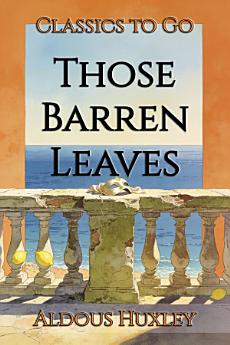
Those Barren Leaves: Restored Classics to Go Edition
About this ebook
Discover more
About the author
Aldous Huxley was an English novelist, essayist, and thinker born into a distinguished intellectual family in 1894, and his life unfolded across some of the most turbulent decades of the twentieth century. Educated at Oxford and shaped by early illness that affected his sight, he developed a sharp, observant style that would make him one of the era's most distinctive literary voices. Over a long career, he wrote novels, criticism, travel writing, essays, and philosophical works, becoming especially known for his satirical portrayals of modern society, his probing of moral uncertainty, and his wide-ranging curiosity about science, religion, politics, and human consciousness. His fiction often examines the emptiness beneath wealth, status, and fashionable ideas, while his later writing turns toward questions of spirituality, self-knowledge, and the limits of technological progress. These concerns remain strikingly relevant today, in an age still wrestling with consumerism, distraction, ideological conflict, and the search for meaning in an increasingly mediated world. Huxley's legacy lies in his ability to combine intellectual daring with literary elegance, offering readers both social critique and philosophical depth. He remains especially rewarding for readers who enjoy witty, idea-driven fiction, incisive cultural commentary, and books that challenge them to think as well as to read.