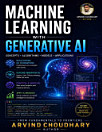
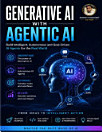
About this ebook
The book begins with Python programming fundamentals and introduces essential libraries such as NumPy, Pandas, Matplotlib, Seaborn, SciPy, Scikit-learn, TensorFlow, PyTorch, OpenCV, NLTK, and LangChain. Readers will learn how these libraries are used for data analysis, visualization, machine learning, natural language processing, computer vision, and AI application development.
It then explores the core concepts of Machine Learning, including data preprocessing, feature engineering, supervised learning, unsupervised learning, model evaluation, hyperparameter tuning, and deployment. Practical examples and real-world projects help readers understand algorithms such as Linear Regression, Decision Trees, Random Forest, Support Vector Machines, K-Nearest Neighbors, Naïve Bayes, Clustering, and Neural Networks.
A major highlight of this book is its in-depth coverage of Agentic AI, the next generation of intelligent systems capable of reasoning, planning, memory management, and autonomous decision-making. Readers will learn how to design and build AI agents using modern frameworks such as LangChain, LangGraph, CrewAI, AutoGen, LiteLLM, MCP (Model Context Protocol), and Retrieval-Augmented Generation (RAG). The book also explains AI workflows, multi-agent systems, tool integration, vector databases, prompt engineering, and AI orchestration.
The book includes numerous hands-on examples, coding exercises, interview questions, and real-world case studies to strengthen practical skills. Whether your goal is to become a Machine Learning Engineer, AI Developer, Data Scientist, or Agentic AI Engineer, this book provides the knowledge and practical experience needed to build modern AI-powered applications.
Key Features
Comprehensive coverage of Python programming and essential Python libraries
Hands-on Machine Learning concepts with real-world datasets
Practical implementation using Scikit-learn, TensorFlow, and PyTorch
Data preprocessing, visualization, feature engineering, and model evaluation
Deep learning fundamentals and neural network implementation
Complete introduction to Agentic AI and autonomous AI systems
LangChain, LangGraph, CrewAI, AutoGen, LiteLLM, MCP, and RAG implementation
Prompt Engineering and AI workflow automation
Vector databases, embeddings, memory, and tool calling
End-to-end AI projects with step-by-step explanations
Interview questions, coding exercises, and best practices
Suitable for beginners, students, developers, researchers, and AI professionals
This book serves as a complete learning resource for mastering Python Libraries, Machine Learning, and Agentic AI Programming, enabling readers to confidently develop intelligent, scalable, and production-ready AI applications for today's rapidly evolving technology landscape.
Discover more
Ratings and reviews
About the author
Arvind Choudhary is an experienced Software Developer, Corporate Trainer, and Technology Mentor from India with around 12 years of professional experience in the IT industry. He has worked extensively for 8 years as a developer and 4 years as a corporate trainer, helping students, professionals, and organizations build strong technical skills in modern software technologies.
He specializes in Java Full Stack Development, Python Full Stack Development, MERN Stack, Flutter, Android Development, Artificial Intelligence (AI), Machine Learning (ML), Generative AI, Agentic AI, AI Agents, and Android Firmware Development.
Throughout his career, Arvind Choudhary has trained and mentored numerous students and working professionals through live projects, practical implementation, industry-focused training, and real-world application development. His teaching approach focuses on simplifying complex technical concepts into easy-to-understand practical learning experiences.
As an author and trainer, he is passionate about sharing knowledge in emerging technologies including Generative AI, AI Automation, Prompt Engineering, Large Language Models (LLMs), and modern software engineering practices. His goal is to help learners become industry-ready developers and technology innovators.
Arvind Choudhary continues to contribute to the technology community through technical training, content creation, software development, and educational initiatives focused on next-generation technologies.