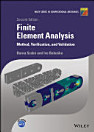
Introduction to Finite Element Analysis: Formulation, Verification and Validation

· Wiley Series in Computational Mechanics Book 35 · Sold by John Wiley & Sons
Ebook
384
Pages
Tools

About this ebook

When using numerical simulation to make a decision, how can its reliability be determined? What are the common pitfalls and mistakes when assessing the trustworthiness of computed information, and how can they be avoided?

Whenever numerical simulation is employed in connection with engineering decision-making, there is an implied expectation of reliability: one cannot base decisions on computed information without believing that information is reliable enough to support those decisions. Using mathematical models to show the reliability of computer-generated information is an essential part of any modelling effort.

Giving users of finite element analysis (FEA) software an introduction to verification and validation procedures, this book thoroughly covers the fundamentals of assuring reliability in numerical simulation. The renowned authors systematically guide readers through the basic theory and algorithmic structure of the finite element method, using helpful examples and exercises throughout.

  • Delivers the tools needed to have a working knowledge of the finite element method
  • Illustrates the concepts and procedures of verification and validation
  • Explains the process of conceptualization supported by virtual experimentation
  • Describes the convergence characteristics of the h-, p- and hp-methods
  • Covers the hierarchic view of mathematical models and finite element spaces
  • Uses examples and exercises which illustrate the techniques and procedures of quality assurance
  • Ideal for mechanical and structural engineering students, practicing engineers and applied mathematicians
  • Includes parameter-controlled examples of solved problems in a companion website (www.wiley.com/go/szabo)
When using numerical simulation to make a decision, how can its reliability be determined? What are the common pitfalls and mistakes when assessing the trustworthiness of computed information, and how can they be avoided? Whenever numerical simulation is employed in connection with engineering d...

Discover more

About the author

Barna Szabó is co-founder and president of Engineering Software Research and Development, Inc. (ESRD), the company that produces the professional finite element analysis software StressCheck®. Prior to his retirement from the School of Engineering and Applied Science of Washington University in 2006 he served as the Albert P. and Blanche Y. Greensfelder Professor of Mechanics. His primary research interest is assurance of quality and reliability in the numerical stimulation of structural and mechanical systems by the finite element method. He has published over 150 papers in refereed technical journals. Several of them in collaboration with Professor Ivo Babuška, with whom he also published a book on finite element analysis (John Wiley & Sons, Inc., 1991). He is a founding member and Fellow of the US Association for Computational Mechanics. Among his honors are election to the Hungarian Academy of Sciences as External Member and an honorary doctorate.

Ivo Babuška’s research has been concerned mainly with the reliability of computational analysis of mathematical problems and their applications, especially by the finite element method. He was the first to address a posteriori error estimation and adaptivity in finite element analysis. His research papers on these subjects published in the 1970s have been widely cited. His joint work with Barna Szabó on the p-version of the finite element method established the theoretical foundations and the algorithmic structure for this method. His recent work has been concerned with the mathematical formulation and treatment of uncertainties which are present in every mathematical model. In recognition of his numerous important contributions, Professor Babuška received may honors, which include honorary doctorates, medals and prizes and election to prestigious academies.

Barna Szabó is co-founder and president of Engineering Software Research and Development, Inc. (ESRD), the company that produces the professional finite element analysis software StressCheck®. Prior to his retirement from the School of Engineering and Applied Science of Washington University in 2...

Rate this ebook

Tell us what you think.

Reading information

Smartphones and tablets
Install the Google Play Books app for Android and iPad/iPhone. It syncs automatically with your account and allows you to read online or offline wherever you are.
Laptops and computers
You can listen to audiobooks purchased on Google Play using your computer's web browser.
eReaders and other devices
To read on e-ink devices like Kobo eReaders, you'll need to download a file and transfer it to your device. Follow the detailed Help Center instructions to transfer the files to supported eReaders.