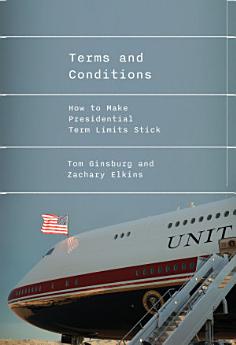
Terms and Conditions: How to Make Presidential Term Limits Stick
About this ebook
“Should we do one more one more term? Well, we’re entitled to it, because they cheated like hell in the second.” —Donald Trump
In March 2025, less than three months into his second term, Donald Trump announced that he was serious about considering a third term in office. MAGA-red “Trump 2028” hats began to appear for sale, and Department of Justice lawyers began to suggest that a new administration might not materialize for another seven years. Officials and supporters began to talk about which policy goals needed to be pursued immediately, and which could be put off until “T3,” the third term.
Outside the United States, the problem of executive term limit violations has been a central one. Over the past two centuries, of presidents who reach the maximum term for which they were first elected, fully one quarter will try to stay on. While Terms and Conditions uses the Trump flirtation with a third term as a springboard, Constitution experts Tom Ginsburg and Zachary Elkins draw on their comparative analysis of over eight hundred constitutions from more than two hundred countries, as well as interviews with a dozen ex-presidents from around the world, to present a more enduring account of the rationale, efficacy, and optimal design of presidential term limits.
Making the argument that the enforcement of presidential term limits is both critical to democracy and an impediment to the consolidation of power, the authors introduce a suite of inducements that have been deployed effectively around the globe—from generous pensions, security arrangements, and high-profile international postings, to limited forms of immunity, and opportunities outside of politics—to make sure presidents leave office on time.
Discover more
About the author
Tom Ginsburg is the Leo Spitz Professor of International Law at the University of Chicago and the author of five books, including the prizewinning Democracies and International Law and (with Zachary Elkins). He co-directs the Comparative Constitutions Project, co-edits the blog of the International Journal of Constitutional Law, and produces the Entitled podcast. He lives in Chicago.
Zachary Elkins is a professor of government at the University of Texas and co-directs the Comparative Constitutions Project with Tom Ginsburg. The author lives in Austin, Texas.