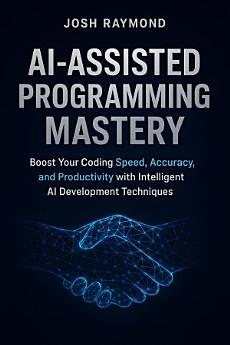
AI-ASSISTED PROGRAMMING MASTERY: Boost Your Coding Speed, Accuracy, and Productivity with Intelligent AI Development Techniques.
About this ebook
AI-ASSISTED PROGRAMMING MASTERY is a practical guide to using artificial intelligence as a powerful development partner without surrendering engineering judgment, code quality, security, or control. It takes you beyond simple autocomplete and basic prompting to a disciplined approach for using AI across the software development lifecycle.
The book begins by examining the rapidly changing landscape of AI-assisted programming and the evolution of coding assistants into increasingly capable systems that can understand repositories, generate features, refactor code, run tests, interact with development tools, and support complex engineering workflows. You’ll learn how to evaluate different approaches, understand the architectural differences that matter in practice, and choose tools that fit your programming languages, projects, teams, security requirements, and workflow.
A major focus is prompt engineering for production-grade code. Instead of relying on vague instructions and accepting whatever an AI model produces, you’ll learn how to provide the right context, define precise objectives, establish constraints, use examples effectively, structure outputs, and refine prompts systematically. The book introduces the CORE framework and explores context engineering, persona prompting, constraint-driven development, example-driven programming, iterative prompting, and domain-specific prompt libraries.
The book also tackles one of the most important challenges in AI-assisted development: verification. AI-generated code can appear polished while still containing bugs, security vulnerabilities, performance problems, or architectural flaws. You’ll explore a layered verification approach involving static analysis, automated testing, property-based testing, differential fuzzing, security scanning, performance validation, and human architectural review.
From there, the focus expands from individual coding tasks to complete software features. You’ll learn how to take a requirement from an initial idea through architecture, implementation, testing, observability, and deployment using structured AI-assisted workflows. The book also explores repository-scale refactoring, technical-debt reduction, legacy modernization, and methods for using AI to accelerate architectural exploration and system design.
Beyond individual developers, AI-assisted programming is changing how engineering organizations operate. The book examines team adoption, leadership, process redesign, developer workflows, code review, onboarding, productivity measurement, organizational resistance, and the ethical and legal considerations involved in introducing AI into professional software development.
The final section looks toward the next stage of programming, including agentic development workflows, self-improving codebases, multimodal systems, compiler-integrated AI, verified code generation, and the changing skills developers will need as AI becomes increasingly integrated into software engineering.
Whether you are a professional developer, software engineer, technical lead, architect, founder, or experienced programmer who wants to increase development velocity without sacrificing quality, AI-ASSISTED PROGRAMMING MASTERY provides a structured framework for making AI a more effective part of your engineering workflow.
Write faster. Think more strategically. Verify more rigorously. Build better software with AI.