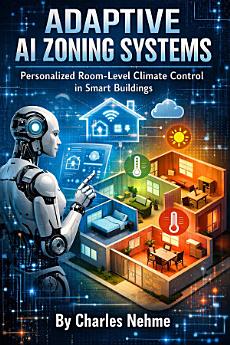
ADAPTIVE AI ZONING SYSTEMS: Personalized Room-Level Climate Control in Smart Buildings
About this ebook
That era is ending.
Adaptive AI Zoning Systems represent a convergence of three powerful technological streams: the maturation of machine learning into practical, deployable algorithms; the proliferation of low-cost, high-fidelity sensing hardware; and the accumulating pressure on building operators to demonstrate measurable reductions in energy consumption without sacrificing — and ideally while improving — occupant comfort and wellbeing.
This book is written for the practitioner who wants to understand not just what these systems do, but how they do it: the data they consume, the models they build, the decisions they make, and the ways they fail. It is also written for the building owner, the facilities director, and the sustainability officer who must evaluate competing vendor claims, justify capital investment, and explain to skeptical tenants why the thermostat now seems to have a mind of its own.
Across twelve chapters, we move from foundational principles through implementation detail to real-world operational challenges. We cover the physics of heat transfer and airflow, the mathematics of reinforcement learning and occupancy prediction, the engineering of sensor networks and edge computing platforms, and the human factors that determine whether a sophisticated system is embraced or circumvented by the people it serves.
The technology described here is not hypothetical. The case studies draw on documented deployments in commercial office towers, hospitals, university campuses, and mixed-use residential developments. The algorithms have been tested, the savings measured, and the failures — instructive as they are — honestly reported.
Climate change is the defining infrastructure challenge of our time, and buildings account for roughly forty percent of global energy consumption. Heating, ventilation, and air conditioning represents the single largest slice of that enormous share. Getting HVAC right — at the room level, in real time, adapted continuously to real human behavior — is not a luxury feature. It is an engineering imperative.
Welcome to the age of intelligent air.
Discover more
About the author
Profile https://bit.ly/m/HVAC