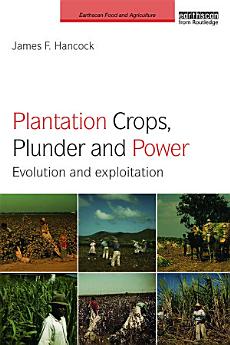
Plantation Crops, Plunder and Power: Evolution and exploitation

· Routledge
Ebook
210
Pages
Eligible

About this ebook

Over the last five centuries, plantation crops have represented the best and worst of industrialized agriculture – "best" through their agronomic productivity and global commercial success, and "worst" as examples of exploitative colonialism, conflict and ill-treatment of workers. This book traces the social, political and evolutionary history of seven major plantation crops – sugarcane, banana, cotton, tea, tobacco, coffee and rubber.

It describes how all of these were domesticated in antiquity and grown by small landowners for thousands of years before European traders and colonists sought to make a profit out of them. The author relates how their development and spread were closely associated with government expansionist policies. They stimulated the exploration of far off lands, were the focus of major conflicts and led to the enslavement of both native and displaced peoples.

From the southern United States, Latin America and the Caribbean, to Asia and Africa, plantation crops turned social structures upside down leading to revolution and government change. The economies of whole countries became tied to the profits of these plantations, leading to internal power struggles to control the burgeoning wealth. Open warfare routinely broke out between the more powerful countries and factions for trade dominance. This book shows that from the early 1500s to today, at least one of the plantation crops was always at the center of world politics, and that this still continues today, for example with the development of oil palm plantations in Southeast Asia. Written in an accessible style, it is fascinating supplementary reading for students of agricultural, environmental and colonial history.
Over the last five centuries, plantation crops have represented the best and worst of industrialized agriculture – "best" through their agronomic productivity and global commercial success, and "worst" as examples of exploitative colonialism, conflict and ill-treatment of workers. This book trace...

Discover more

About the author

James F. Hancock is Professor Emeritus, Department of Horticulture, Michigan State University, USA. He is author of Plant Evolution and the Origin of Crop Species, now in its third edition.

Rate this ebook

Tell us what you think.

Reading information

Smartphones and tablets
Install the Google Play Books app for Android and iPad/iPhone. It syncs automatically with your account and allows you to read online or offline wherever you are.
Laptops and computers
You can listen to audiobooks purchased on Google Play using your computer's web browser.
eReaders and other devices
To read on e-ink devices like Kobo eReaders, you'll need to download a file and transfer it to your device. Follow the detailed Help Center instructions to transfer the files to supported eReaders.