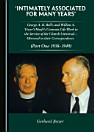
'Intimately Associated for Many Years': George K. A. Bell's and Willem A. Visser 't Hooft's Common Life-Work in the Service of the Church Universal – Mirrored in their Correspondence (Part Two 1950-1958), Part 2
Nov 2015 · Cambridge Scholars Publishing
Ebook
598
Pages
family_home
Eligible
info
About this ebook
The Anglican Bishop George Bell (of Chichester) and the General Secretary of the World Council of Churches, Willem A. Visser’t Hooft (of Geneva) exchanged hundreds of letters between 1938 and 1958. The correspondence, reproduced and commented upon here, mirrors the efforts made across the ecumenical movement to unite the Christian churches and also to come to terms with an age of international crisis and conflict. In these first decades of the World Council, it was widely felt that the Church could make a noteworthy contribution to the mitigation of political tensions all over the world. That’s why Bell and Visser’t Hooft talked not only to bishops and the clergy, but also to the prime ministers and presidents of many countries. They raised their voices in memoranda and published their public letters in important newspapers. This was the World Council’s most successful period.
The Anglican Bishop George Bell (of Chichester) and the General Secretary of the World Council of Churches, Willem A. Visser’t Hooft (of Geneva) exchanged hundreds of letters between 1938 and 1958. The correspondence, reproduced and commented upon here, mirrors the efforts made across the ecumeni...
Discover more
About the author
Gerhard Besier is a historian (PhD), theologian (DD) and psychologist (Diploma). In 2009, he received an honorary doctorate from the University of Lund, Sweden. He has held chairs in Contemporary (Church) History at the Universities of Berlin, Heidelberg and Dresden, is currently Director of the Sigmund Neumann Institute, and teaches at Stanford University. His book The Holy See and Hitler's Germany was published by Palgrave in 2007. This was followed in 2013 by European Dictatorships: A comparative history of the twentieth century (Cambridge Scholars Publishing), co-edited with Katarzyna Stoklosa, and then by Neither Good Nor Bad. Why Human Beings Behave How They Do (Cambridge Scholars Publishing, 2014).
Gerhard Besier is a historian (PhD), theologian (DD) and psychologist (Diploma). In 2009, he received an honorary doctorate from the University of Lund, Sweden. He has held chairs in Contemporary (Church) History at the Universities of Berlin, Heidelberg and Dresden, is currently Director of the ...
Rate this ebook
Tell us what you think.
Reading information
Smartphones and tablets
Install the Google Play Books app for Android and iPad/iPhone. It syncs automatically with your account and allows you to read online or offline wherever you are.
Laptops and computers
You can listen to audiobooks purchased on Google Play using your computer's web browser.
eReaders and other devices
To read on e-ink devices like Kobo eReaders, you'll need to download a file and transfer it to your device. Follow the detailed Help Center instructions to transfer the files to supported eReaders.