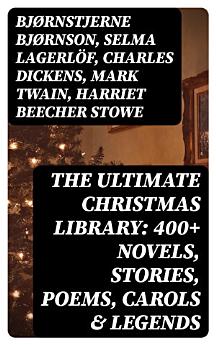
The Ultimate Christmas Library: 400+ Novels, Stories, Poems, Carols & Legends
Bjørnstjerne Bjørnson · Selma Lagerlöf · Charles Dickens · Mark Twain · Harriet Beecher Stowe · Martin Luther · Robert Louis Stevenson · William Shakespeare · Henry Wadsworth Longfellow · Max Brand · William Wordsworth · Carolyn Wells · Charles Mackay · John Addington Symonds · Sophie May · Louisa May Alcott · Henry Van Dyke · Frances Hodgson Burnett · Andrew Lang · Frances Ridley Havergal · Alphonse Daudet · William John Locke · Walter Scott · Gustavo Adolfo Bécquer · Booth Tarkington · Benito Pérez Galdós · Elizabeth Cleghorn Gaskell · Armando Palacio Valdés · William Morris · Anthony Trollope · Marcel Prévost · Rudyard Kipling · Beatrix Potter · Robert Herrick · Mary Hartwell Catherwood · Emily Dickinson · Bret Harte · Hamilton Wright Mabie · Meredith Nicholson · Lucas Malet · Isaac Watts · James Russell Lowell · James Whitcomb Riley · Thomas Nelson Page · O. Henry · Phillips Brooks · Saki · William Makepeace Thackeray · Sarah Orne Jewett · François Coppée · Oliver Bell Bunce · Susan Coolidge · Samuel McChord Crothers · Maud Lindsay · Alice Hale Burnett · Walter Crane · André Theuriet · Amy Ella Blanchard · Isabel Cecilia Williams · Evaleen Stein · Amanda M. Douglas · Edgar Wallace · George Wither · Booker T. Washington · Olive Thorne Miller · Vernon Lee · Anne Hollingsworth Wharton · Henry Vaughan · Eliza Cook · Kate Upson Clark · Ben Jonson · Ernest Ingersoll · Frank Samuel Child · Willis Boyd Allen · Georgianna M. Bishop · Edward Thring · F. L. Stealey · James Selwin Tait · Tudor Jenks · L. Frank Baum · C. N. Williamson · A. M. Williamson · J. M. Barrie · Eleanor H. Porter · Annie F. Johnston · Jacob A. Riis · Elbridge S. Brooks · Edward A. Rand · Florence L. Barclay · E. T. A. Hoffmann · Harrison S. Morris · Robert E. Howard · Marjorie L. C. Pickthall · Sarah P. Doughty · Hans Christian Andersen · William Butler Yeats · Richard Watson Gilder · Lucy Maud Montgomery · Anton Chekhov · Mary Louisa Molesworth · Leo Tolstoy · Fyodor Dostoevsky · Cecil Frances Alexander · Mary E. Wilkins Freeman · Margaret Deland · William Drummond · Robert Southwell · Reginald Heber · Alfred Lord Tennyson · George Macdonald · A. S. Boyd · Maxime Du Camp · Mary Austin · Juliana Horatia Ewing · Guy De Maupassant · Brothers Grimm · Clement Moore · Susan Anne Livingston · Ridley Sedgwick · Selma Lagerlof · Nora A. Smith · Phebe A. Curtiss · Nellie C. King · Lucy Wheelock · Aunt Hede · Frederick E. Dewhurst · Jay T. Stocking · Anna Robinson · Florence M. Kingsley · M. A. L. Lane · Elizabeth Harkison · Raymond Mcalden · F. E. Mann · Winifred M. Kirkland · Katherine Pyle · Grace Margaret Gallaher · Elia W. Peattie · F. Arnstein · James Weber Linn · Antonio Maré · Pedro A. De Alarcón · Jules Simon · Marion Clifford · E. E. Hale · Georg Schuster · Matilda Betham Edwards · Angelo J. Lewis · William Francis Dawson · Christopher North · Alfred Domett · Dinah Maria Mulock · James S. Park · Edmund Hamilton Sears · Edmund Bolton · C.s. Stone · Harriet F. Blodgett · John G. Whittier · Christian Burke · Emily Huntington Miller · Cyril Winterbotham · Enoch Arnold Bennett · John Punnett Peters
Nov 2022 · DigiCat
Ebook
10534
Pages
family_home
Eligible
info
About this ebook
The Ultimate Christmas Library: 400+ Novels, Stories, Poems, Carols & Legends offers a comprehensive exploration of holiday literature, weaving together an eclectic tapestry of narratives that celebrate the many facets of Christmas. This anthology traverses genres and eras, from timeless tales of generosity and redemption to enchanting folklore and enduring carols. Exploring themes of compassion, joy, and reflection, the collection includes standout pieces that resonate with the spirit of the season and the magic it inspires, providing a literary feast that caters to all tastes within the context of Christmas literature's rich tradition. The impressive array of contributors, ranging from beloved storytellers like Charles Dickens and Louisa May Alcott to poets such as Emily Dickinson and Alfred Lord Tennyson, ensures a diversity of perspectives and voices. These authors hail from varied backgrounds and have shaped literary and cultural movements essential to the anthology's themes. Through such diversity, the collection not only embodies the historical and cultural shifts surrounding Christmas but also enriches the reader's understanding of how these narratives have evolved to reflect societal changes and universal values. This anthology is an invaluable resource for readers seeking a multifaceted exploration of Christmas literature. It presents a unique opportunity to immerse oneself in a wide range of literary styles and perspectives, offering educational insights and fostering dialogue across time and culture. Whether you are looking for heartwarming stories or reflective poems, The Ultimate Christmas Library serves as a perfect companion for the holiday season, inviting readers to explore the profound and joyous themes that have come to define this cherished time of year.
The Ultimate Christmas Library: 400+ Novels, Stories, Poems, Carols & Legends offers a comprehensive exploration of holiday literature, weaving together an eclectic tapestry of narratives that celebrate the many facets of Christmas. This anthology traverses genres and eras, from timeless tales of...
Discover more
About the author
Bjørnstjerne Bjørnson (1832–1910), a towering figure in Norwegian literature, was a playwright, poet, and novelist, whose contribution is forever etched in the annals of Nordic letters. Born in the village of Kvikne, in Østerdalen, Norway, Bjørnson's literary career was marked by his deep engagement with the Norwegian national spirit, which paralleled the cultural and political movements leading towards Norway's eventual independence from Sweden. His multifaceted career encapsulated the roles of an influential journalist, a fervid political activist, and an author whose works conveyed his ardent nationalist sentiments. The recipient of the 1903 Nobel Prize in Literature, Bjørnson is best known for his poems, plays, and novels that address social issues and the quest for identity in a rapidly changing Norway. His contribution to literature extends to the rich body of Christmas literature, as alluded to by his inclusion in 'The Ultimate Christmas Library: 400+ Novels, Stories, Poems, Carols & Legends.' His literary style often combined realism with lyrical themes, shining through a canon of works that resonate with love for the Norwegian land and people. Bjørnson's narrative prowess and his command of the Norwegian language played a pivotal role in shaping the literary identity of a nation in transition and continues to be celebrated throughout the Scandinavian literary tradition.
Bjørnstjerne Bjørnson (1832–1910), a towering figure in Norwegian literature, was a playwright, poet, and novelist, whose contribution is forever etched in the annals of Nordic letters. Born in the village of Kvikne, in Østerdalen, Norway, Bjørnson's literary career was marked by his deep engagem...
Rate this ebook
Tell us what you think.
Reading information
Smartphones and tablets
Install the Google Play Books app for Android and iPad/iPhone. It syncs automatically with your account and allows you to read online or offline wherever you are.
Laptops and computers
You can listen to audiobooks purchased on Google Play using your computer's web browser.
eReaders and other devices
To read on e-ink devices like Kobo eReaders, you'll need to download a file and transfer it to your device. Follow the detailed Help Center instructions to transfer the files to supported eReaders.