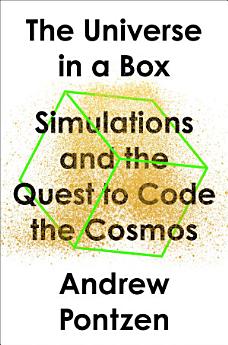
The Universe in a Box: Simulations and the Quest to Code the Cosmos
Jun 2023 · Sold by Penguin
Ebook
272
Pages
Tools
info
family_home
Eligible
info
About this ebook
Scientists are using simulations to recreate the universe, revealing the hidden nature of reality.
Cosmology is a tricky science—no one can make their own stars, planets, or galaxies to test its theories. But over the last few decades a new kind of physics has emerged to fill the gap between theory and experimentation. Harnessing the power of modern supercomputers, cosmologists have built simulations that offer profound insights into the deep history of our universe, allowing centuries-old ideas to be tested for the first time. Today, physicists are translating their ideas and equations into code, finding that there is just as much to be learned from computers as experiments in laboratories.
In The Universe in a Box, cosmologist Andrew Pontzen explains how physicists model the universe’s most exotic phenomena, from black holes and colliding galaxies to dark matter and quantum entanglement, enabling them to study the evolution of virtual worlds and to shed new light on our reality.
But simulations don’t just allow experimentation with the cosmos; they are also essential to myriad disciplines like weather forecasting, epidemiology, neuroscience, financial planning, airplane design, and special effects for summer blockbusters. Crafting these simulations involves tough compromises and expert knowledge. Simulation is itself a whole new branch of science, one that we are only just beginning to appreciate and understand. The story of simulations is the thrilling history of how we arrived at our current knowledge of the world around us, and it provides a sneak peek at what we may discover next.
Scientists are using simulations to recreate the universe, revealing the hidden nature of reality.
Cosmology is a tricky science—no one can make their own stars, planets, or galaxies to test its theories. But over the last few decades a new kind of physics has emerged to fill the gap between the...
Discover more
About the author
Andrew Pontzen is a professor of cosmology at University College London. He has written for New Scientist, BBC Sky at Night, and BBC Focus; lectured at the Royal Institution; and been featured as an expert on PBS’s NOVA, the Discovery Channel’s How the Universe Works, and other shows. Simulations are a major part of his research which spans cosmology, physics and computation. He lives in London.
Andrew Pontzen is a professor of cosmology at University College London. He has written for New Scientist, BBC Sky at Night, and BBC Focus; lectured at the Royal Institution; and been featured as an expert on PBS’s NOVA, the Discovery Channel’s How the Universe Works, and other shows. Simulations...
Rate this ebook
Tell us what you think.
Reading information
Smartphones and tablets
Install the Google Play Books app for Android and iPad/iPhone. It syncs automatically with your account and allows you to read online or offline wherever you are.
Laptops and computers
You can listen to audiobooks purchased on Google Play using your computer's web browser.
eReaders and other devices
To read on e-ink devices like Kobo eReaders, you'll need to download a file and transfer it to your device. Follow the detailed Help Center instructions to transfer the files to supported eReaders.


