About this ebook
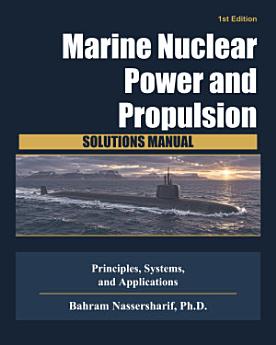
The manual supports study across reactor physics and neutronics, thermal hydraulics, heat transfer, materials, fuel management, shielding, steam cycles, propulsion plant integration, instrumentation, control, and safety analysis. Computational topics include Monte Carlo methods, deterministic neutronics, thermal-hydraulic modeling, and multiphysics analysis. Additional problems address historical and contemporary marine reactors, advanced concepts, commercial applications, regulation, safeguards, and lifecycle management.
Quantitative solutions develop governing equations, assumptions, intermediate calculations, and checks where appropriate. Conceptual and design problems provide explanations or suggested approaches, helping readers connect technical principles with engineering judgment. The emphasis throughout is on clear reasoning, consistent units, traceable inputs, and recognition of the limits of a calculation or model.
Chapter and problem numbering align with the companion textbook, allowing readers to move between the two volumes. The manual contains the problem sets and their solutions; the textbook provides the explanatory chapters and worked examples.
Designed for coursework, independent study, and instructional reference, this volume helps readers strengthen their analytical skills and apply nuclear engineering methods to the distinctive challenges of marine power and propulsion.
Discover more
About the author
Bahram Nassersharif, Ph.D., is a Distinguished University Professor of Mechanical Engineering and Applied Mechanics at the University of Rhode Island, where he directs the Nuclear Engineering Program and the Capstone Design Program. His career spans more than four decades in nuclear engineering, computational science, and engineering education.
He previously served as Dean of Engineering at the University of Rhode Island, led supercomputing centers at Texas A&M University and the University of Nevada, Las Vegas, and worked as a project leader and principal investigator at Los Alamos National Laboratory. His expertise includes nuclear reactor design, safety analysis, safeguards, nuclear propulsion and power systems, and computational modeling of complex engineering systems.
Dr. Nassersharif earned his doctorate in nuclear engineering, with a graduate minor in applied mathematics, and his bachelor’s degree in mathematics from Oregon State University. He is a Fellow of the American Association for the Advancement of Science and a recipient of the Presidential Young Investigator Award.
His books cover nuclear reactor engineering, marine and space nuclear power and propulsion, and engineering capstone design. Through his research, teaching, and writing, he connects scientific principles with practical engineering analysis and multidisciplinary design, preparing students and professionals to address complex technical challenges.