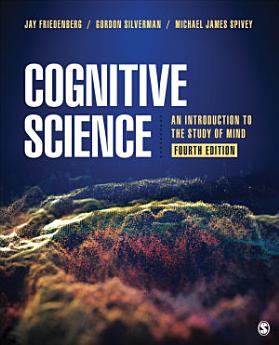
Cognitive Science: An Introduction to the Study of Mind, Edition 4
About this ebook
About the author
Jay Friedenberg is Professor of the Psychology Department at Manhattan College, where he directs the Cognitive Science Program. He is interested in both vision and the philosophy of mind. He teaches courses in physiological psychology, cognition and learning, sensation and perception, and artificial intelligence and robotics. He has published several articles on visual estimation of center of mass. His current research projects focus on the aesthetics of geometrical shapes. He has published books on artificial intelligence, dynamical systems theory, and psychology. He is a member of the International Association of Empirical Aesthetics, the Eastern Psychological Association, the Vision Science Society, the Psychonomic Society, and Phi Beta Kappa. He obtained his PhD in cognitive psychology in 1995 at the University of Virginia.
Gordon Silverman is Professor Emeritus of Electrical and Computer Engineering at Manhattan College. His professional career spans more than 55 years of corporate, teaching, consulting, and research experience, during which he has developed a range of scientific instruments, particularly for use in physiological psychology research environments. He is the holder of eight patents, some related to behavior modification. The author of more than 20 journal articles and books, he has also served on the faculties of The Rockefeller University and Fairleigh Dickinson University. His current research interests include telemedicine, rehabilitation medicine, artificial intelligence, and biomedical instrumentation and modeling. He holds engineering degrees from Columbia University and received a PhD in system science from New York University Polytechnic School of Engineering in 1972.
Michael Spivey is Professor of Cognitive Science at the University of California, Merced. He earned his B.A. in Psychology at the University of California, Santa Cruz, and his Ph.D. in Brain and Cognitive Sciences at the University of Rochester. After 12 years as a psychology professor at Cornell University, Spivey moved to UC Merced to help build their Department of Cognitive and Information Sciences. He has published over 100 journal articles and book chapters on the embodiment of cognition, and interactions between language, vision, memory, syntax, semantics, and motor movement. His research uses eye-tracking, computer-mouse tracking, and dynamical systems theory to explore how brain, body, and environment work together to make a mind what it is. In 2010, Spivey received the William Procter Prize for Scientific Achievement from the Sigma Xi Scientific Research Honor Society.