Machine Learning Solutions for Inverse Problems: Part A

· · ·
· Handbook of Numerical Analysis Book 26 · Academic Press
Ebook
500
Pages
Eligible

About this ebook

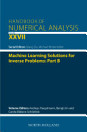
Machine Learning Solutions for Inverse Problems: Part A, Volume 26 in the Handbook of Numerical Analysis, highlights new advances in the field, with this new volume presenting interesting chapters on a variety of timely topics, including Data-Driven Approaches for Generalized Lasso Problems, Implicit Regularization of the Deep Inverse Prior via (Inertial) Gradient Flow, Generalized Hardness of Approximation, Hallucinations, and Trustworthiness in Machine Learning for Inverse Problems, Energy-Based Models for Inverse Imaging Problems, Regularization Theory of Stochastic Iterative Methods for Solving Inverse Problems, and more.Other sections cover Advances in Identifying Differential Equations from Noisy Data Observations, The Complete Electrode Model for Electrical Impedance Tomography: A Comparative Study of Deep Learning and Analytical Methods, Learned Iterative Schemes: Neural Network Architectures for Operator Learning, Jacobian-Free Backpropagation for Unfolded Schemes with Convergence Guarantees, and Operator Learning Meets Inverse Problems: A Probabilistic Perspective - Provides the authority and expertise of leading contributors from an international board of authors - Presents the latest release in the Handbook of Numerical Analysis series - Updated release includes the latest information on the Machine Learning Solutions for Inverse Problems
Machine Learning Solutions for Inverse Problems: Part A, Volume 26 in the Handbook of Numerical Analysis, highlights new advances in the field, with this new volume presenting interesting chapters on a variety of timely topics, including Data-Driven Approaches for Generalized Lasso Problems, Impl...

Discover more

About the author

Andreas Hauptmann received his PhD in 2017 from the University of Helsinki in Applied Mathematics. He currently holds a position as Academy Research Fellow and Associate Professor (tenure track) of Computational Mathematics at the Research Unit of Mathematical Sciences, University of Oulu, and as Honorary Associate Professor at the Department of Computer Science, University College London. His research interest is in inverse problems and tomographic imaging, with a focus on combining model-based inversion techniques with data-driven methods and the study of their theoretical properties.

Bangti Jin received a PhD in Mathematics from The Chinese Universityof Hong Kong, Hong Kong in 2008. Previously, he was Lecturer and Reader, and Professor at Department of Computer Science, UniversityCollege London (2014-2022), an assistant professor of Mathematics at the University of California, Riverside (2013–2014), a visiting assistant professor at Texas A&M University (2010–2013), an Alexandre von Humboldt Postdoctoral Researcher at University of Bremen (2009–2010). Currently he is Professor of Mathematics, Global STEM Scholar, at The Chinese University of Hong Kong. His research interests include inverse problems, numerical analysis and machine learning.

Carola-Bibiane Schönlieb graduated from the Institute for Mathematics, University of Salzburg (Austria) in 2004. From 2004 to 2005 she held a teaching position in Salzburg. She received her PhD degree from the University of Cambridge (UK) in 2009. After one year of postdoctoral activity at the University of Göttingen (Germany), she became a Lecturer at Cambridge in 2010, promoted to Reader in 2015 and promoted to Professor in 2018. Since 2011 she is a fellow of Jesus College Cambridge. She currently is Professor of Applied Mathematics (2006) at the University of Cambridge where she is head of the Cambridge Image Analysis group. Her current research interests focus on variational methods, partial differential equations and machine learning for image analysis, image processing and inverse imaging problems.
Andreas Hauptmann received his PhD in 2017 from the University of Helsinki in Applied Mathematics. He currently holds a position as Academy Research Fellow and Associate Professor (tenure track) of Computational Mathematics at the Research Unit of Mathematical Sciences, University of Oulu, and as...

Rate this ebook

Tell us what you think.

Reading information

Smartphones and tablets
Install the Google Play Books app for Android and iPad/iPhone. It syncs automatically with your account and allows you to read online or offline wherever you are.
Laptops and computers
You can listen to audiobooks purchased on Google Play using your computer's web browser.
eReaders and other devices
To read on e-ink devices like Kobo eReaders, you'll need to download a file and transfer it to your device. Follow the detailed Help Center instructions to transfer the files to supported eReaders.