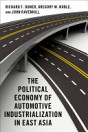
Industrial Competitiveness of the Auto Parts Industries in Four Large Asian Countries: The Role of Government Policy in a Challenging International Environment
Richard F. Doner · Gregory W. Noble · John Ravenhill
Jan 2006 · World Bank Publications
star
1 review
Ebook
76
Pages
Tools
info
About this ebook
Abstract: Rationalization and stabilization following the Asian financial crisis of the late 1990s combined with the expansion and liberalization of regional and global trade to create significant parts industries in China, Indonesia, and the Republic of Korea. Conventional policies of stabilization and liberalization, however, cannot fully explain growth patterns. Japan and Korea grew into major players before liberalizing trade and investment, while even after extensive liberalization Indonesia has yet to move from extensive to intensive growth. These anomalies suggest that to explain success in the auto parts industry we need to move beyond liberalization to look at policies and institutions promoting economies of scale, skill formation, quality upgrading, supplier-linkage cooperation, and innovation. In Japan, the regional and global leader, innovative assemblers led industrial development and supported key suppliers, but the government also supported diffusion of quality control techniques and new technology to small and medium enterprises, and encouraged stable employment among core employees. Korea remains weaker on both small and medium enterprise and employment fronts, but government-encouraged consolidation around a small number of business groups, an extended period of protection, and support for export promotion led to economies of scale. Liberalization of foreign investment after the financial crisis helped ameliorate the excessive statism of earlier policies and strengthened the parts industry. In China, liberalization for WTO entry, rapid expansion in demand, and strong support by local governments encouraged a wave of foreign investment in both assembly and parts. In contrast, institutional weaknesses continue to constrain development opportunities in Indonesia.
Abstract: Rationalization and stabilization following the Asian financial crisis of the late 1990s combined with the expansion and liberalization of regional and global trade to create significant parts industries in China, Indonesia, and the Republic of Korea. Conventional policies of stabilizat...
Ratings and reviews
1 review
Rate this ebook
Tell us what you think.
Reading information
Smartphones and tablets
Install the Google Play Books app for Android and iPad/iPhone. It syncs automatically with your account and allows you to read online or offline wherever you are.
Laptops and computers
You can listen to audiobooks purchased on Google Play using your computer's web browser.
eReaders and other devices
To read on e-ink devices like Kobo eReaders, you'll need to download a file and transfer it to your device. Follow the detailed Help Center instructions to transfer the files to supported eReaders.