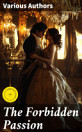
The Forbidden Passion: The Greatest Historical Romance Novels Of All Time
Charlotte Brontë · Anne Brontë · Emily Brontë · Henry James · Samuel Richardson · Jane Austen · Thomas Hardy · Edith Wharton · Maria Edgeworth · Henry Fielding · Alexandre Dumas · Mary Wollstonecraft · Nathaniel Hawthorne · William Makepeace Thackeray · Grace Livingston Hill · Fanny Burney · Georgette Heyer · Eliza Haywood · Leo Tolstoy · Pierre Choderlos de Laclos · Mrs. Olifant
Nov 2023 · DigiCat
Ebook
14407
Pages
family_home
Eligible
info
About this ebook
The anthology 'The Forbidden Passion' masterfully assembles a collection of literature that explores the timeless theme of love's complexity and the conflicts born from societal constraints. Spanning a rich tapestry of literary styles, the works within this volume traverse the spectrum from the delicate nuance of Regency romances to the dramatic gravitas of Victorian narratives, intertwining realism with romanticism. Readers will encounter diverse explorations of passion, morality, and societal norms, exemplified by narratives that provoke thought and emotion without singular authorship dominating the discourse. Instead, the collection weaves a variety of motifs from the sentimental to the scandalous, each piece selecting a facet of human desire. The esteemed collection of contributors to 'The Forbidden Passion' introduces readers to the profoundly distinct voices of Charlotte, Anne, and Emily Brontë, along with the likes of Samuel Richardson and Alexandre Dumas, whose works have paved the pathways of romantic literature. This diverse assemblage includes authors from the Romantic to the Edwardian era, drawing on historical and cultural movements that challenge or conform to contemporary moral expectations. Each story or novel excerpt reflects an interplay of personal convictions and societal pressures, with the collection resonating with anyone familiar with the intricacies of personal freedoms and cultural influences. Ideal for both literary aficionados and those new to the genre, 'The Forbidden Passion' offers a compelling journey through multiple dimensions of love and restriction, presenting a remarkable opportunity to engage with a wide variety of perspectives and styles. This anthology stands as an essential addition to any bibliophile's library, presenting not just tales of forbidden desire but a dialogue between eras and attitudes. It encourages readers to consider the intricate interplay of passion and propriety while showcasing the transformation of love narratives over time, making it an invaluable resource for exploring the evolution of romantic discourse.
The anthology 'The Forbidden Passion' masterfully assembles a collection of literature that explores the timeless theme of love's complexity and the conflicts born from societal constraints. Spanning a rich tapestry of literary styles, the works within this volume traverse the spectrum from the d...
Discover more
About the author
Charlotte Brontë (1816–1855), an English novelist and poet, is heralded as a seminal figure in the world of Victorian literature. Her nuanced exploration of the socio-emotional struggles faced by her characters has earned her an esteemed place among the literary greats. Born in Thornton, West Yorkshire, Brontë was the third of six children and secured her literary legacy with novels that consistently delve into themes of unrequited love, moral and psychological defiance, and gender dichotomies. Notably, Brontë authored the classic 'Jane Eyre' (1847), which underpinned her sophisticated use of first-person narrative to drive intimate and intense psychological portraits. Another significant work attributed to her is 'Shirley' (1849), notable for its distinctive approach to industrial unrest and female independence. However, the purported work 'The Forbidden Passion' does not align with the known canon of Charlotte Brontë's literature. Such divergence casts doubt on its authenticity, suggesting it may not be a genuine work by Brontë but rather a posthumously attributed or mistakenly cited one. Nevertheless, her acknowledged publications, including 'Villette' (1853) and 'The Professor' (published posthumously in 1857), showcase Brontë's penetrating prose and her pioneering role in the development of the modern novel. Her literary style remains an inspiration for its emotional depth, vivid characters, and the melding of Gothic elements with social realism, which continues to resonate with contemporary readers and scholars alike.
Charlotte Brontë (1816–1855), an English novelist and poet, is heralded as a seminal figure in the world of Victorian literature. Her nuanced exploration of the socio-emotional struggles faced by her characters has earned her an esteemed place among the literary greats. Born in Thornton, West Yor...
Rate this ebook
Tell us what you think.
Reading information
Smartphones and tablets
Install the Google Play Books app for Android and iPad/iPhone. It syncs automatically with your account and allows you to read online or offline wherever you are.
Laptops and computers
You can listen to audiobooks purchased on Google Play using your computer's web browser.
eReaders and other devices
To read on e-ink devices like Kobo eReaders, you'll need to download a file and transfer it to your device. Follow the detailed Help Center instructions to transfer the files to supported eReaders.