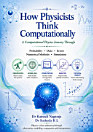
Physics Through Computation
About this ebook
The book enables readers to develop the ability to translate physical laws into computational models and to analyse systems that do not admit closed form analytical solutions. Emphasis is placed on nonlinear behaviour, coupled systems, and data driven problems that require numerical treatment. The content is organised as a progression from physical formulation to algorithmic representation and implementation. Each topic is introduced through a physical problem, followed by its reformulation into a computational procedure, and implemented using spreadsheets and C programming. This design maintains a consistent connection between physical meaning and computational method.
The primary intention is to establish computation as a central tool in physics, grounded in modelling, approximation, iteration, and interpretation. Numerical methods are presented not as isolated techniques, but as extensions of physical reasoning. Readers gain practical competence in root finding, numerical integration, differential equations, linear systems, and data analysis, along with the ability to evaluate numerical accuracy and uncertainty. The approach supports the development of independent problem solving skills and encourages the use of simulation as a means of investigation. Intended for postgraduate students, the book provides a coherent framework for applying computation to physical systems and for engaging with contemporary scientific problems where analytical methods alone are insufficient.
Discover more
Ratings and reviews

- Flag inappropriate
About the author
Dr Kamsali Nagaraja is a Professor of Physics at Bangalore University, India, with expertise in Atmospheric, Space, and Planetary Physics. His work integrates analytical modelling, mathematical methods, and computational simulation for complex dynamical systems. As principal architect of the trilogy, he has shaped its synthesis of mathematical structure, algorithmic formulation, and disciplined scientific modelling in contemporary physics education.
Dr Susheela KL is an Assistant Professor of Physics at Bangalore University, specializing in Solid State Physics and Materials Science. With interdisciplinary training in Education and Computer Applications, she brings a structured pedagogical perspective to computational modelling and simulation-based learning. Her work strengthens the integration of mathematical methods, numerical implementation, and conceptual clarity in education.