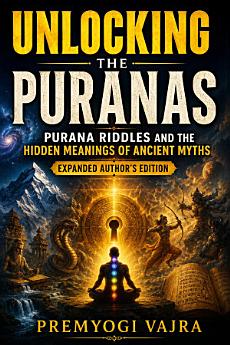
UNLOCKING THE PURANAS: Purana Riddles and the Hidden Meanings of Ancient Myths : Expanded Author's Edition
About this ebook
Ancient mythological stories have long been treated as religion or folklore. This book reveals them as something far deeper: a symbolic science of human consciousness.
Purana Riddles: Decoding the Hidden Meanings of the Puranas invites the reader to look beyond mythology and into the symbolic intelligence encoded within ancient Indian scriptures.
For centuries, the Puranas have captivated human imagination through stories of gods, demons, cosmic events, and divine dramas. While these narratives appear mythological on the surface, they were carefully crafted to preserve subtle spiritual knowledge in a form accessible to society at large. This book explores the idea that such stories were never mere fiction, but allegorical representations of inner psychological and spiritual processes.
At the heart of these narratives lies the esoteric science of Kundalini Yoga—a knowledge too subtle to be explained directly in ancient times. To ensure its continuity, sages embedded this wisdom within metaphors, symbols, and mythological characters. Over generations, readers absorbed these ideas unconsciously, often experiencing joy, inspiration, and inner transformation without realizing the source.
Through a logical, analytical, and experiential approach, this book decodes the metaphors of the Puranas and reveals how they describe stages of consciousness, inner awakening, and spiritual evolution. Rather than promoting belief or ritual, it encourages understanding, clarity, and personal inquiry.
The book bridges ancient spirituality with modern reasoning, demonstrating that metaphors do not replace truth—they illuminate it. By examining mythological symbols as psychological and spiritual signposts, Purana Riddles offers a fresh perspective on texts that have shaped human thought for millennia.
This work is intended for readers who:
Seek meaning beyond literal interpretations
Are curious about consciousness and inner transformation
Wish to explore spirituality through reason rather than blind belief
Purana Riddles does not ask the reader to accept mythology—it invites them to decode it.
Discover more
Ratings and reviews

- Flag inappropriate
About the author
Premyogi Vajra is not a conventional teacher—he is a direct explorer of consciousness whose work arises from lived experience rather than formal scholarship or institutional teaching.
Author of more than 60 books in Hindi and English, his writing spans a wide spectrum of inquiry into spirituality, inner awareness, and human perception. Yet, his work is not rooted in abstract theory—it emerges from direct observation and practical exploration of consciousness itself.
His journey into inner transformation has been shaped by deep meditation, tantric understanding, and what he calls practical spiritual research—an approach that places experience above belief. Along this path, he has encountered profound states of awareness, including moments where the sense of individuality dissolves into a unified field of consciousness—states often described in yogic traditions as samadhi.
He has undergone two significant awakenings. The first unfolded spontaneously in a dream state during adolescence. The second arose through deliberate and systematic yogic practice in his forties. He has also reached states approaching keval kumbhak—the spontaneous suspension of breath—associated with nirvikalpa samadhi. Yet, he remains grounded in the understanding that such realization is not fully stabilized, and continues his practice with sincerity and dedication.
During his first awakening, he observed nonduality directly. Inspired by that experience, he intuitively developed Sharirvigyan Darshan as a practical framework to help maintain an awakened state while living in the world, to a greater or lesser extent. With this he got second awakening. After his second awakening, he similarly developed its equivalent and nondual Quantum Darshan through intuitive insight arising from that experience.
Rather than following rigid systems or borrowed doctrines, his path has been intuitive and experiential—focused on directly perceiving truth rather than adopting it from external authorities.
Beyond his inner explorations, Premyogi Vajra lives a balanced and grounded life. He has a deep interest in organic farming and animal welfare, reflecting his connection with nature and sustainable living. He enjoys meaningful cinema with his family, often combining it with travel and shared experiences.
His journeys are not merely recreational—they are driven by curiosity, observation, and a desire to understand life in its diverse expressions. In his quieter moments, he turns to music, playing the flute, harmonium, and guitar. Reading and writing remain his inborn passions.
Through his work, he does not seek followers, nor does he promote fixed doctrines. Instead, he extends an invitation—
to question, to explore, and to discover truth directly.
This book is one such invitation.