About this ebook
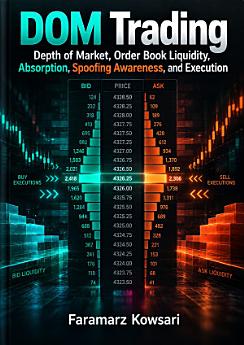
Depth of Market, Order Book Liquidity, Absorption, Spoofing Awareness, and Execution
Candlestick charts show what happened. The Depth of Market shows part of the auction while it is still happening.
Between one candle and the next, thousands of decisions may be entered, cancelled, repriced, matched, partially filled, absorbed, or withdrawn. Most of that process disappears when activity is compressed into a conventional price bar.
DOM Trading takes the reader inside that missing layer.
This is an applied guide to Depth of Market, order-book liquidity, bid and ask behavior, aggressive and passive order flow, absorption, exhaustion, queue position, liquidity migration, spoofing awareness, execution, and market microstructure. Its purpose is not to turn every flickering number on a ladder into a trading signal. It teaches traders how to separate what the market actually displays from what they merely imagine it means.
The distinction matters.
A DOM can reveal visible liquidity and completed transactions in real time, but it does not remove uncertainty. The book therefore develops a disciplined sequence of observation: locate price, examine displayed liquidity, distinguish resting orders from executed trades, compare aggressive effort with actual price response, and select an execution method appropriate to the evidence. That methodology is stated explicitly in the book's preface. DOM_Trading_Faramarz_Kowsari
The order book is not a prediction machine. It is an auction.
The early chapters build the market-microstructure foundation needed to understand what appears on a DOM ladder: bid, ask, spread, midpoint, tick size, resting depth, market orders, limit orders, matching priority, executed-at-bid volume, executed-at-ask volume, and working orders.
From there, the book addresses a question every serious DOM trader eventually encounters:
What does displayed liquidity actually mean?
Large resting size can attract attention, but size alone does not prove support, resistance, institutional intent, or an imminent reversal. Liquidity can remain, reload, migrate, or disappear. A trader therefore needs to study persistence and sequence rather than react to a single snapshot.
That leads naturally into one of the book's central skills: distinguishing passive liquidity from aggressive execution.
Readers learn how buyers lift offers, how sellers hit bids, how executed volume differs from resting orders, and why Delta becomes meaningful only when compared with the resulting price response. The book repeatedly asks the trader to compare effort with result: substantial aggressive buying with little upward progress tells a different story from the same buying pressure rapidly clearing offers and advancing price. DOM_Trading_Faramarz_Kowsari
Absorption, Exhaustion, Reloading, and Icebergs
The book develops a practical framework for understanding absorption: situations where substantial aggressive effort repeatedly fails to produce corresponding price progress.
But absorption is carefully separated from exhaustion. A market can stop moving because opposing liquidity absorbs pressure, or because the original aggression simply disappears. Those mechanisms may look superficially similar on a chart while implying very different auction dynamics.
Separate chapters examine reloading, reserve orders, iceberg behavior, visible versus hidden quantity, refresh behavior, and the limits of inference. The goal is not to claim that every replenishing level is a hidden institutional order, but to teach what can reasonably be inferred from repeated execution and what remains unknowable.
Spoofing Awareness Without Paranoia
Modern order books contain cancellations, rapidly changing quotes, automated participation, and sometimes deceptive activity. DOM Trading addresses spoofing and layering without teaching traders to label every disappearing order as manipulation.
The book distinguishes legal definitions from visual assumptions and emphasizes a crucial principle:
Cancellation alone proves very little.
Displayed liquidity must be studied in context, over time, and alongside executed transactions.
This leads to a deeper treatment of the liquidity-wall mirage: large visible bids and offers that attract traders precisely because they appear obvious. Readers learn to examine whether a wall persists, moves, vanishes, reloads, trades, or fails to produce the expected response.
Context turns DOM data into useful information.
The book then connects the ladder to key market locations: overnight highs and lows, session extremes, opening ranges, value references, breakouts, breakdowns, and areas where real-time liquidity behavior becomes worth watching.
Dedicated chapters explore liquidity sweeps, failed continuation, trapped participation, session structure, changing market regimes, and cross-market confirmation or divergence.
Rather than presenting a sweep as an automatic reversal signal, the framework asks what happens after liquidity is taken. Does price accept the new area? Does aggression continue? Does the market reclaim the broken level? Does the order book support or contradict the story being told by the chart?
Execution is where DOM analysis becomes real.
A trader may read the auction correctly and still produce a poor result through weak execution.
For that reason, the book devotes substantial attention to market orders, limit orders, queue position, partial fills, missed-trade risk, entry execution, exit execution, spread, slippage, fill quality, stops, position sizing, and execution mathematics. These topics form a major section of the book rather than an afterthought. DOM_Trading_Faramarz_Kowsari
The reader learns why a touched price is not necessarily a filled order, why queue position matters, why simulated fills can differ dramatically from live trading, and why a seemingly tiny execution cost can accumulate across repeated trades.
DOM Across Markets
The framework also examines DOM behavior across futures, equities, cryptocurrency, and foreign exchange, acknowledging an essential reality: market structure differs between centralized and fragmented venues. The information visible on one futures exchange is fundamentally different from the partial liquidity picture available in a fragmented equity, crypto, or FX environment. The book explicitly covers these cross-market limitations. DOM_Trading_Faramarz_Kowsari
Learn to read sequences, not screenshots.
Perhaps the most valuable shift in the book is from static pattern recognition to event sequencing.
A single large bid is a photograph.
A bid that remains, receives repeated selling, reloads, survives, disappears, or moves is a process.
DOM trading lives in the process.
The final sections therefore focus on replay, tick drills, event recording, tagging, slow-motion review, blind pauses, execution rehearsal, and deliberate practice. Readers are encouraged to stop replay before the outcome is visible, record the most conservative interpretation supported by the evidence, and only then reveal what happened next. This directly attacks hindsight bias, one of the most dangerous weaknesses in discretionary order-flow analysis. The book's replay and deliberate-practice chapters are specifically designed around this progression. DOM_Trading_Faramarz_Kowsari
The book concludes with multi-stage DOM case studies, an operating framework, an order-flow glossary, observation and execution checklists, a replay protocol, a DOM trading journal template, and a visual companion designed for rapid review.
DOM Trading is written for futures traders, active equities traders, order-flow students, scalpers, execution-focused traders, and anyone who has opened a DOM ladder and wondered what the constantly changing numbers actually mean.
The objective is not to predict sooner. It is to observe more precisely, execute more intelligently, and recognize uncertainty before it becomes an expensive assumption.
Discover more
About the author
Faramarz Kowsari
Faramarz Kowsari is an author, researcher based in Istanbul. Focusing on the intersection of technology, education, and personal growth, he has published over 80 digital titles on international platforms. His areas of expertise span Artificial Intelligence, prompt engineering, modern trading strategies (Smart Money Concepts & algorithmic trading), as well as classical literature and mindfulness. In addition to writing, he develops web-based educational tools and creates specialized instructional video content.
Official Profiles & Repositories:
• Official Website: https://FaramarzKowsari.
• Books Intro Page: https://FaramarzKowsari.
• Google Play Books: https://play.viewpro.live/store/
• LinkedIn: https://www.linkedin.com/in/