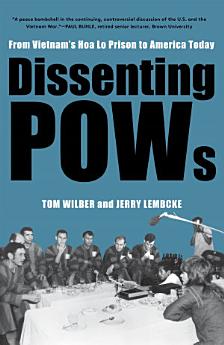
Dissenting POWs: From Vietnam’s Hoa Lo Prison to America Today
About this ebook
Even if you don't know much about the war in Vietnam, you've probably heard of "The Hanoi Hilton," or Hoa Lo Prison, where captured U.S. soldiers were held. What they did there and whether they were treated well or badly by the Vietnamese became lasting controversies. As military personnel returned from captivity in 1973, Americans became riveted by POW coming-home stories. What had gone on behind these prison walls? Along with legends of lionized heroes who endured torture rather than reveal sensitive military information, there were news leaks suggesting that others had denounced the war in return for favorable treatment. What wasn't acknowledged, however, is that U.S. troop opposition to the war was vast and reached well into Hoa Loa Prison. Half a century after the fact, Dissenting POWs emerges to recover this history, and to discover what drove the factionalism in Hoa Lo.
Looking into the underlying factional divide between pro-war “hardliners” and anti-war “dissidents” among the POWs, authors Wilber and Lembcke delve into the postwar American culture that created the myths of the Hero-POW and the dissidents blamed for the loss of the war. What they found was surprising: It wasn’t simply that some POWs were for the war and others against it, nor was it an officers-versus-enlisted-men standoff. Rather, it was the class backgrounds of the captives and their pre-captive experience that drew the lines. After the war, the hardcore hero-holdouts—like John McCain—moved on to careers in politics and business, while the dissidents faded from view as the antiwar movement, that might otherwise have championed them, disbanded. Today, Dissenting POWs is a necessary myth-buster, disabusing us of the revisionism that has replaced actual GI resistance with images of suffering POWs—ennobled victims that serve to suppress the fundamental questions of America’s drift to endless war.
Discover more
Ratings and reviews
About the author
Tom Wilber investigates documentation regarding U.S. detainees in the Democratic Republic of Việt Nam from 1964 until 1973. His research is the source for the 2015 Hà Nội National Film Festival award-winning documentary, The Flower Pot Story, produced by Ngọc Dũng. A visiting lecturer at Hà Nội University in 2018, his opinion pieces have been published in Việt Nam News. Wilber represents a U.S.-based nongovernmental organization that works on humanitarian projects with Vietnamese organizations.
Jerry Lembcke (Author)
Jerry Lembcke grew up in Northwest Iowa. He was drafted in 1968 and served as a Chaplain’s Assistant in Vietnam. He is the author of eight books including The Spitting Image, CNN’s Tailwind Tail, and Hanoi Jane. His opinion pieces have appeared in The New York Times, Boston Globe, and The Chronicle of Higher Education. He is presently Associate Professor of Sociology, Emeritus, at Holy Cross College and Distinguished Lecturer for the Organization of American Historians.