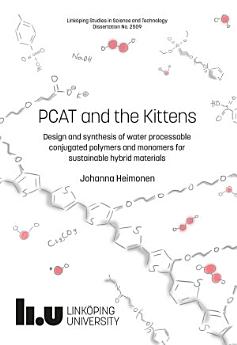
PCAT and the Kittens: Design and synthesis of water processable conjugated polymers and monomers for sustainable hybrid materials

· Linköping Studies in Science and Technology. Dissertations · Linköping University Electronic Press
Ebook
203
Pages

About this ebook

The transition to a greener society requires a comprehensive approach to the development of new materials. Starting already at the material design stage, with the aim to reduce the impact on health, climate and environment during the material’s entire lifetime. Novel material designs can, for example, be biobased (entirely or partially), allow for water-based processing, or facilitate separation of materials at end-of-life for recovery or reuse. Conjugated polymers (CPs) stand out as a class of organic materials because of their physical and opto-electronic properties, which can be tuned by their chemical design. CPs are made from abundant elements and have been explored in combination with biobased substrates such as cellulose, to create reinforced electroactive hybrid materials for wearable electronics. Despite recent advances in synthesis, processing and recycling of CPs, it remains a challenge to unify water-processability with electrical stability and benign material recovery. In this thesis, the aim was to explore greener CP designs and synthesis for more sustainable hybrid materials. This was done via the introduction of functional groups that enable, for example, aqueous processing and chemical recovery of CPs.

The polar polythiophene PCAT was obtained by introducing a carboxylate functional group to the CP sidechain, giving pH-tunable water solubility and processability. PCAT could be fixated onto and recovered from Lyocell cellulose thread substrates with simple acid-base chemistry. Acid-mediated oxygen doping was used to obtain electrically conducting CP:cellulose threads. The doping resulted in loss of recoverability of the CP due to hydrogen peroxide triggered formation of covalent bonds. A potassium iodide-based strategy for preventing unwanted crosslinking resulted in stable, conductive, and removable electroactive coatings on cellulose threads, using water as the sole solvent.

The scope of the oxa-Michael addition for sidechain functionalization was explored as a way of achieving new CP-functionalities. Based on the chemical design of the CAT-monomer, 5 monomer derivatives were synthesized using neat oxa-Michael addition reactions optimized via small scale screening. Carboxylate, amide and phosphonate functionality were all successfully installed via oxa-Michael addition at moderate to excellent yields. 

In a final project, synthesis of water-soluble conjugated monomers allowed development of a fully water based direct arylation polymerization protocol. Simple thiophene and thienothiophene based polymers were synthesized by using water-soluble monomers and benign additives for catalyst solubility.

In summary, this work has advanced the knowledge of water-processable polar polythiophenes and their function and challenges as removable electroactive cellulose coatings. Further, oxa-Michael addition has been proven as a versatile way to synthesize functionalized glycolated thiophene monomers and a promising direct arylation polymerization strategy in water (WaDAP) has been developed.

The transition to a greener society requires a comprehensive approach to the development of new materials. Starting already at the material design stage, with the aim to reduce the impact on health, climate and environment during the material’s entire lifetime. Novel material designs can, for exa...

Discover more

Rate this ebook

Tell us what you think.

Reading information

Smartphones and tablets
Install the Google Play Books app for Android and iPad/iPhone. It syncs automatically with your account and allows you to read online or offline wherever you are.
Laptops and computers
You can listen to audiobooks purchased on Google Play using your computer's web browser.
eReaders and other devices
To read on e-ink devices like Kobo eReaders, you'll need to download a file and transfer it to your device. Follow the detailed Help Center instructions to transfer the files to supported eReaders.