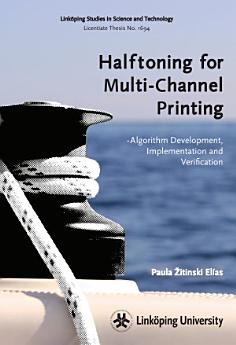
Halftoning for Multi-Channel Printing: Algorithm Development, Implementation and Verification
About this ebook
The first focus in this thesis is on the implementation of an amplitude modulated (AM) halftoning method for seven-channel printing utilizing CMYKRGB colorants. The proposed AM halftoning method utilizes non-orthogonal halftone screens instead of orthogonal ones (dots), thus enabling a wider angle range for the channels that makes possible to accommodate multi-channel impressions. The performance of the non-orthogonal halftoning method was evaluated by computational simulation of channel misregistration for 1600 different scenarios and assessment of printed orthogonal and non-orthogonal patches. The simulated and printed results demonstrate that the proposed halftoning method utilizing non-orthogonal screens shows no visible moiré and produces smaller colour shifts in case of misregistration when compared to orthogonal halftoning.
However, the layer thickness of the combined colorants is not controlled by the aforementioned multi-channel AM halftoning approach. Therefore, the second focus in this thesis concerns the adjustment and implementation of a multilevel halftoning algorithm for achromatic and chromatic inks. In this algorithm, a channel is processed so that it can be printed using multiple inks of same hue value, achieving a single ink layer. Here, the thresholds for ink separation and dot gain compensation pose an interesting challenge. Since dot gain originates from the interaction between a specific ink and specific paper, compensating the original image for multilevel halftoning means expressing the dot gain of multiple inks in terms of the nominal coverage of a single ink. The applicability of the proposed multilevel halftoning workflow is demonstrated using multiple inks while avoiding dot-on-dot placement and accounting for dot gain. The results also show that the multilevel halftoned image is visually improved in terms of graininess and detailenhancement when compared to a bi-level halftoned image.
Discover more
Ratings and reviews

- Flag inappropriate