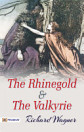
Stories from Wagner
Richard Wagner · J. Walker McSpadden
Jun 2022 · DigiCat
Ebook
163
Pages
family_home
Eligible
info
About this ebook
In 'Stories from Wagner', the rich tapestry of Richard Wagner's operatic narratives is deftly unravelled into a collection of eight gripping tales, adapted with fervor and artistic sensibility. The book transposes Wagner's leitmotifs from the grand stage to the intimate corners of literary expression, offering readers the essence of epics like 'The Ring of the Curse', 'Parsifal the Pure', and 'Lohengrin the Swan Knight', among others. Crafted with an eye for both the profundities of tragedy and the enchantments of mystery, Wagner's poignant storytelling captures the imagination through a style that is as melodious to the mind's ear as his operas are to the physical one, resonating within a wide continuum of literary and musical contexts. Richard Wagner, primarily revered as one of the most significant composers in Western music history, reveals another facet of his boundless creativity in 'Stories from Wagner'. His deep understanding of human passions and weaknesses, paired with a dramatic flair that shaped his operatic compositions, propels the narrative force of each story. These retellings reflect not just Wagner's mythical and legendary preoccupations but also his philosophical musings, thereby shedding light on the intricate interplay between his musical genius and literary acumen. 'Stories from Wagner' offers a compelling invitation to both aficionados of Wagner's operatic oeuvre and newcomers eager for an entry point into his world. It promises a journey through tales that balance the gravity of epic destinies with the intimacy of personal struggles, all the while echoing the timeless themes that Wagner so passionately explored in his music. As such, the book is recommended for those who appreciate storytelling woven with thematic complexity and those interested in the intersections of music and literature, promising an experience that enriches the heart as much as it stimulates the intellect.
In 'Stories from Wagner', the rich tapestry of Richard Wagner's operatic narratives is deftly unravelled into a collection of eight gripping tales, adapted with fervor and artistic sensibility. The book transposes Wagner's leitmotifs from the grand stage to the intimate corners of literary expres...
Discover more
About the author
Richard Wagner (1813–1883) was a preeminent German composer, theatre director, and conductor who left an indelible mark on the musical landscape of the 19th century. Wagner's contributions to literature were not as extensive as his musical compositions, but they reflect the same thematic preoccupations and artistic ideals. His work 'Stories from Wagner' serves as a narrative compendium to his operas, which are themselves steeped in mythological motifs and epic storytelling. Wagner's literary style echoes his operatic ethos, characterized by grandiose narratives and a deep examination of human emotions, often interweaving mythology with his innovative concepts, such as the leitmotif—a recurring musical phrase associated with a character, theme, or emotion. While better known for his monumental operatic works such as 'The Ring of the Nibelung,' 'Tristan und Isolde,' and 'Parsifal,' which have altered the course of Western music, Wagner's literary pursuits demonstrate his commitment to a Gesamtkunstwerk, or 'total artwork,' wherein different art forms are synthesized into a cohesive whole. His essays and autobiographical writings further illuminate his philosophical musings and the evolution of his artistic vision. Wagner's legacy persists, influencing not only music and opera but also leaving a mark on literature through his theoretical writings and storytelling.
Richard Wagner (1813–1883) was a preeminent German composer, theatre director, and conductor who left an indelible mark on the musical landscape of the 19th century. Wagner's contributions to literature were not as extensive as his musical compositions, but they reflect the same thematic preoccup...
Rate this ebook
Tell us what you think.
Reading information
Smartphones and tablets
Install the Google Play Books app for Android and iPad/iPhone. It syncs automatically with your account and allows you to read online or offline wherever you are.
Laptops and computers
You can listen to audiobooks purchased on Google Play using your computer's web browser.
eReaders and other devices
To read on e-ink devices like Kobo eReaders, you'll need to download a file and transfer it to your device. Follow the detailed Help Center instructions to transfer the files to supported eReaders.