No One’s Ways: An Essay on Infinite Naming
Mar 2017 · Princeton University Press
Ebook
336
Pages
family_home
Eligible
info
About this ebook
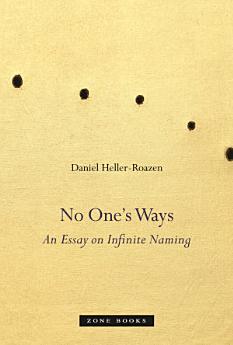
Homer recounts how, trapped inside a monster’s cave, with nothing but his wits, Ulysses once saved himself by twisting his name. He called himself Outis: “No One” or “Non-One,” “No Man” or “Non-Man.” The ploy was a success. He blinded his barbaric host and eluded him, becoming anonymous, for a while, even as he bore a name.
Philosophers never forgot the lesson that the ancient hero taught. From Aristotle and his commentators in Greek, Arabic, Latin, and more modern languages, from the masters of the medieval schools to Kant and his many successors, thinkers have exploited the possibilities of adding “non-” to the names of man.
Aristotle is the first to write of “indefinite” or “infinite” names, his example being “non-man.” Kant turns to such terms in his theory of the infinite judgment, illustrated by the sentence, “The soul is non-_mortal.” Such statements play unexpected and often major roles in the systems of Salomon Maimon, Hegel and Hermann Cohen, before being variously and profoundly reinterpreted in the twentieth century.
Reconstructing the adventures of a particle in philosophy, Heller-Roazen’s book shows how a grammatical possibility can be an incitement for thought. Yet it also draws a lesson from persistent examples. The philosophers’ infinite names all point to one subject: us. “Non-man” or “soul,” “Spirit” or “the unconditioned,” we are beings who name and name ourselves, bearing witness to the fact that we are, in every sense, unnamable.
Homer recounts how, trapped inside a monster’s cave, with nothing but his wits, Ulysses once saved himself by twisting his name. He called himself Outis: “No One” or “Non-One,” “No Man” or “Non-Man.” The ploy was a success. He blinded his barbaric host and eluded him, becoming anonymous, for a wh...
About the author
Daniel Heller-Roazen is the Arthur W. Marks '19 Professor of Comparative Literature and the Council of the Humanities at Princeton University. He is the author of Echolalias: On the Forgetting of Language, The Inner Touch: Archaeology of a Sensation, The Enemy of All: Piracy and the Law of Nations, and The Fifth Hammer: Pythagoras and the Disharmony of the World, all published by Zone Books.
Daniel Heller-Roazen is the Arthur W. Marks '19 Professor of Comparative Literature and the Council of the Humanities at Princeton University. He is the author of Echolalias: On the Forgetting of Language, The Inner Touch: Archaeology of a Sensation, The Enemy of All: Piracy and the Law of Nation...
Rate this ebook
Tell us what you think.
Reading information
Smartphones and tablets
Install the Google Play Books app for Android and iPad/iPhone. It syncs automatically with your account and allows you to read online or offline wherever you are.
Laptops and computers
You can listen to audiobooks purchased on Google Play using your computer's web browser.
eReaders and other devices
To read on e-ink devices like Kobo eReaders, you'll need to download a file and transfer it to your device. Follow the detailed Help Center instructions to transfer the files to supported eReaders.