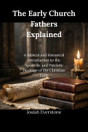
The Essentials of the Early Church Fathers: A Guide to the Foundational Voices That Shaped Christian Doctrine and Biblical Interpretation
About this ebook
What happened to Christian teaching after the Apostles? Who preserved the faith? How did the early Church defend Scripture, Christ, salvation, and the doctrine of the Trinity?
These questions take readers into one of the most important periods in Christian history.
The Essentials of the Early Church Fathers presents a serious yet accessible study of the men who carried Christian teaching through the first centuries of the Church.
From Clement of Rome, Ignatius of Antioch, and Polycarp to Irenaeus, Tertullian, Origen, Athanasius, Basil of Caesarea, Gregory of Nazianzus, Gregory of Nyssa, and Augustine, the book examines the beliefs, writings, controversies, and ministry of influential Christian teachers.
The discussion reaches back to 95 to 96 AD, the commonly accepted period for Clement's First Letter to the Corinthians, and follows the development of Christian thought through the second, third, fourth, and fifth centuries.
Readers will encounter:
• The Apostolic Fathers and their connection with the first Christian generation
• Clement, Ignatius, and Polycarp
• The rise of Christian apologetics in the Roman world
• Justin Martyr and the defense of Christian faith
• Scripture, canon formation, and biblical interpretation
• Irenaeus and the defense of apostolic Christianity
• Tertullian and early Christian doctrine
• Origen and biblical interpretation
• The Arian controversy and the Council of Nicaea in 325 AD
• The Cappadocian Fathers and the doctrine of the Trinity
• Augustine's teaching on grace, sin, salvation, and Christian theology
• Scripture, tradition, the Rule of Faith, and the authority of the Church
• The continuing lessons of patristic Christianity for the modern Church
The historical record is filled with tension. Christians faced accusations of atheism, immorality, political disloyalty and other charges. Teachers defended the faith through reasoned argument and biblical conviction. Councils confronted serious doctrinal disputes. Pastors and bishops carried responsibility for churches living under pressure from both outside opposition and internal division.
The book also brings readers face to face with major dates that changed Christian history.
Clement's letter: approximately 95 to 96 AD.
Irenaeus as bishop of Lyon: approximately 177 to 202 AD.
Tertullian's Apology: approximately 197 AD.
Origen's birth: approximately 185 AD.
Council of Nicaea: 325 AD.
Basil of Caesarea: approximately 330 to 379 AD.
Augustine: 354 to 430 AD.
These dates are not presented merely as historical markers. They place the development of Christian doctrine within the real circumstances in which these teachers lived, preached, suffered, debated, and wrote.
For pastors, clergy, worship leaders, Bible teachers, theology students, seminary readers, Christian educators, and serious students of Church history, this book provides a valuable foundation for understanding the Christian generations that followed the Apostles.
Read the words of the Fathers.
Consider the controversies that tested the Church.
Follow the development of Christian doctrine from the Apostolic Age to Augustine.
Then ask the question that matters most:
What can the earliest generations of Christians teach the Church today?
If Christian history, biblical doctrine, worship, pastoral ministry, apologetics, and the foundations of historic Christian belief matter to you, this is a book to keep close at hand.
Discover more
About the author
Josiah Everstone writes on Christian theology, Church history, doctrine, and the development of Christian thought. His writing focuses on important questions surrounding biblical faith, Christian doctrine, the early Church, and the theological heritage passed from one generation of Christians to another.
In The Essentials of the Early Church Fathers, Everstone presents a twelve chapter study of the early Christian teachers and theological developments that helped preserve and define historic Christian belief.
His work examines the Apostolic Fathers, Christian apologetics, Scripture and canon formation, Irenaeus, Tertullian, Origen, the Council of Nicaea, the Cappadocian Fathers, Augustine, biblical interpretation, church tradition, and the continuing significance of patristic Christianity.
Through accessible historical and theological writing, Josiah Everstone seeks to help pastors, clergy, students, teachers, worship leaders, and serious Christian readers understand the foundations of the faith that preceded the later development of Christian traditions.