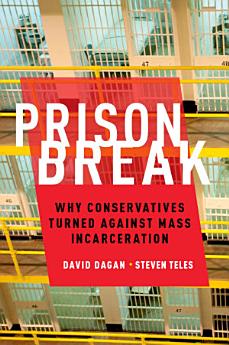
Prison Break: Why Conservatives Turned Against Mass Incarceration
May 2016 · Oxford University Press
star
2 reviews
Ebook
224
Pages
family_home
Eligible
info
About this ebook
American conservatism rose hand-in-hand with the growth of mass incarceration. For decades, conservatives deployed "tough on crime" rhetoric to attack liberals as out-of-touch elitists who coddled criminals while the nation spiraled toward disorder. As a result, conservatives have been the motive force in building our vast prison system. Indeed, expanding the number of Americans under lock and key was long a point of pride for politicians on the right - even as the U.S. prison population eclipsed international records. Over the last few years, conservatives in Washington, D.C. and in bright-red states like Georgia and Texas, have reversed course, and are now leading the charge to curb prison growth. In Prison Break, David Dagan and Steve Teles explain how this striking turn of events occurred, how it will affect mass incarceration, and what it teaches us about achieving policy breakthroughs in our polarized age. Combining insights from law, sociology, and political science, Teles and Dagan will offer the first comprehensive account of this major political shift. In a challenge to the conventional wisdom, they argue that the fiscal pressures brought on by recession are only a small part of the explanation for the conservatives' shift, over-shadowed by Republicans' increasing anti-statism, the waning efficacy of "tough on crime" politics and the increasing engagement of evangelicals. These forces set the stage for a small cadre of conservative leaders to reframe criminal justice in terms of redeeming wayward souls and rolling back government. These developments have created the potential to significantly reduce mass incarceration, but only if reformers on both the right and the left play their cards right. As Dagan and Teles stress, there is also a broader lesson in this story about the conditions for cross-party cooperation in our polarized age. Partisan identity, they argue, generally precedes position-taking, and policy breakthroughs are unlikely to come by "reaching across the aisle," promoting "compromise," or appealing to "expert opinion." Instead, change happens when political movements redefine their own orthodoxies for their own reasons. As Dagan and Teles show, outsiders can assist in this process - and they played a crucial role in the case of criminal justice - but they cannot manufacture it. This book will not only reshape our understanding of conservatism and American penal policy, but also force us to reconsider the drivers of policy innovation in the context of American politics.
American conservatism rose hand-in-hand with the growth of mass incarceration. For decades, conservatives deployed "tough on crime" rhetoric to attack liberals as out-of-touch elitists who coddled criminals while the nation spiraled toward disorder. As a result, conservatives have been the motive...
Discover more
Ratings and reviews
2 reviews
About the author
David Dagan is a Ph.D. candidate in Political Science at Johns Hopkins University. Steven Teles is Associate Professor of Political Science at Johns Hopkins University, and is the author of The Conservative Legal Movement in America (Princeton UP).
David Dagan is a Ph.D. candidate in Political Science at Johns Hopkins University. Steven Teles is Associate Professor of Political Science at Johns Hopkins University, and is the author of The Conservative Legal Movement in America (Princeton UP).
Rate this ebook
Tell us what you think.
Reading information
Smartphones and tablets
Install the Google Play Books app for Android and iPad/iPhone. It syncs automatically with your account and allows you to read online or offline wherever you are.
Laptops and computers
You can listen to audiobooks purchased on Google Play using your computer's web browser.
eReaders and other devices
To read on e-ink devices like Kobo eReaders, you'll need to download a file and transfer it to your device. Follow the detailed Help Center instructions to transfer the files to supported eReaders.