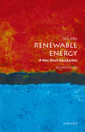
Renewable Energy: A Very Short Introduction, Edition 2
Jun 2026 · Oxford University Press
Ebook
160
Pages
family_home
Eligible
info
About this ebook
Very Short Introductions: Brilliant, Sharp, Inspiring Energy is vital for a good standard of living, and affordable sources of power that do not cause climate change or pollution are crucial. Renewable energy is recognised as providing the answer, with countries from around the world deciding at COP28 in 2023 to aim to triple the global renewable energy capacity by 2030, for the transition away from fossil fields to be on track for net-zero emissions by 2050. This Very Short Introduction describes the main sources of renewable energy- solar PV, wind, hydropower, and biomass - their innovative technologies, and what each could deliver. It also discusses the relatively small contributions expected from tidal, wave, geothermal, and nuclear power, and from carbon capture and storage. Nick Jelley presents how the variability of solar PV and wind power can be handled in an electricity grid predominantly powered by renewables, and discusses recent innovations in batteries and other energy storage technologies. Jelley goes on to explain the importance of decarbonising the huge global heat demand by using heat pumps, hydrogen from electrolysers, and electricity directly; and of changing to electric vehicles, which will decarbonise most of transport. Electrification of buildings, industry and transport for net-zero will roughly triple the supply of electricity, and this can be met predominantly by solar PV and wind power. The learning effect has resulted in a dramatic drop in the price of wind and solar PV power in the last decade, making them the cheapest generators of electricity in most parts of the world. This could make powering the world by renewables considerably cheaper than continuing to burn fossil fuels. Jelley explores the challenges in achieving this; notably, geopolitical tensions, lack of grid infrastructure, permitting (planning) issues, the availability of finance in the global South, and the vested interests in fossil fuels. The Very Short Introduction ends by discussing the actions needed that include strong consistent policies, financial initiatives to take advantage of the long-term benefits of renewables, and good community involvement. ABOUT THE SERIES: The Very Short Introductions series from Oxford University Press contains hundreds of titles in almost every subject area. These pocket-sized books are the perfect way to get ahead in a new subject quickly. Our expert authors combine facts, analysis, perspective, new ideas, and enthusiasm to make interesting and challenging topics highly readable.
Very Short Introductions: Brilliant, Sharp, Inspiring Energy is vital for a good standard of living, and affordable sources of power that do not cause climate change or pollution are crucial. Renewable energy is recognised as providing the answer, with countries from around the world deciding at ...
Discover more
About the author
Nick Jelley is Emeritus Professor in the Department of Physics and a Fellow of Lincoln College at the University of Oxford. He is co-author of Energy Science (2022), with John Andrews.
Nick Jelley is Emeritus Professor in the Department of Physics and a Fellow of Lincoln College at the University of Oxford. He is co-author of Energy Science (2022), with John Andrews.
Rate this ebook
Tell us what you think.
Reading information
Smartphones and tablets
Install the Google Play Books app for Android and iPad/iPhone. It syncs automatically with your account and allows you to read online or offline wherever you are.
Laptops and computers
You can listen to audiobooks purchased on Google Play using your computer's web browser.
eReaders and other devices
To read on e-ink devices like Kobo eReaders, you'll need to download a file and transfer it to your device. Follow the detailed Help Center instructions to transfer the files to supported eReaders.