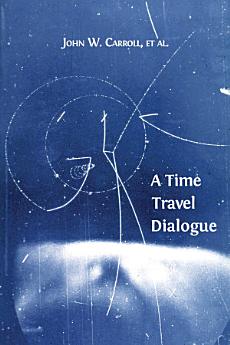
A Time Travel Dialogue
About this ebook
The setting is the Jefferson National Laboratory during a period of five days in 2010. Dr. Rufus’s experimental search for the psi-lepton and the resulting intractable data spurs the discussion on time travel. She and her two colleagues are pushed by their observations to address the grandfather paradox and other puzzles about backwards causation, with attention also given to causal loops, multi-dimensional time, and the prospect that only the present exists. Sensible solutions to the main puzzles emerge, ultimately advancing the case for time travel really being possible.
A Time Travel Dialogue addresses the possibility of time travel, approaching familiar paradoxes in a rigorous, engaging, and fun manner. It follows in the long philosophical tradition of using dialogue to present philosophical ideas and arguments, but is ground breaking in its use of the dialogue format to introduce readers to the metaphysics of time travel, and is also distinctive in its use of lab results to drive philosophical analysis. The discussion of data that might decide whether time is one-dimensional (one timeline) or multi-dimensional (branching time) is especially novel.
Discover more
About the author
John W. Carroll is professor of philosophy at North Carolina State University. His research focuses on metaphysics and philosophy of science, especially the topics of laws of nature, causation, motion, explanation, and time travel. His The Humean Tradition, which appeared in The Philosophical Review, was reprinted in The Philosopher's Annual, XIII, as a top ten philosophy article appearing in 1990. He is the author of Laws of Nature (Cambridge, 1994), co-author with Ned Markosian of An Introduction to Metaphysics (Cambridge, 2010), and the editor of Readings on Laws of Nature (Pittsburgh, 2004). Professor Carroll is, however, most proud of his work as editor and producer of A Time Travel Dialogue and A Time Travel Website, two superb pieces of interdisciplinary and collaborative scholarship done with his metaphysics students.