About this ebook
* What are the strengths and limitations of social surveys?
* How can the principles of surveying be put into practice?
* How are findings analysed and results presented?
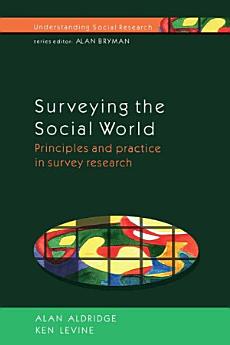
The survey has become a widely used technique for gathering information and opinions from individuals, organizations, and other groups. In Surveying the Social World, Aldridge and Levine begin by examining the contemporary state of surveys within society and social science methodology, explaining the potential of the survey method and the ways it can be used effectively when resources are limited. They then take the reader systematically through the process of conducting survey research covering in turn, the role of theory, the planning and design of projects, pilot work, access to informants, ethical issues, sampling methods, the preparation of questionnaires, interviewing, the use of computer packages, processing responses, statistical methods of data analysis, and the presentation of findings.
Unlike some rival texts that stress complications and difficulties of conducting social surveys, this book adopts a consciously 'can-do' approach, emphasizing strategies and practical tips. Written in a direct style with a clear structure, each chapter begins with a list of key elements and concludes with summary points, points for reflection and suggestions for further reading. As well as examples of techniques and good practice from a variety of surveys, the authors use their own Travel Survey throughout the book to illustrate the decisions that need to be taken at each stage of the survey process. For the technical topics, there is a glossary containing over 130 technical terms that are highlighted in the text. The result is an essential guide to conducting social surveys for students in the social sciences, and for others who need to carry out a community or organizational survey but who may have no previous training in social research methods or experience of survey work.
* What are the strengths and limitations of social surveys?
* How can the principles of surveying be put into practice?
* How are findings analysed and results presented?
The survey has become a widely used technique for gathering information and opinions from individuals, organizations, and oth...
About the author
Alan Aldridge is Senior Lecturer in Sociology at the University of Nottingham. He is the author of Religion in the Contemporary World (2000) and Consumption (forthcoming).
Ken Levine is Lecturer in Sociology and Director of the Survey Unit at the University of Nottingham. He is the author of The Social Context of Literacy (1986).
Ken Levine is Lecturer in Sociology and Director of the Survey Unit at the University of Nottingham. He is the author of The Social Context of Literacy (1986).
Alan Aldridge is Senior Lecturer in Sociology at the University of Nottingham. He is the author of Religion in the Contemporary World (2000) and Consumption (forthcoming).
Ken Levine is Lecturer in Sociology and Director of the Survey Unit at the University of Nottingham. He is the author of The...
Rate this ebook
Tell us what you think.
Reading information
Smartphones and tablets
Install the Google Play Books app for Android and iPad/iPhone. It syncs automatically with your account and allows you to read online or offline wherever you are.
Laptops and computers
You can listen to audiobooks purchased on Google Play using your computer's web browser.
eReaders and other devices
To read on e-ink devices like Kobo eReaders, you'll need to download a file and transfer it to your device. Follow the detailed Help Center instructions to transfer the files to supported eReaders.