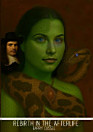
HELL 1666 AMSTERDAM
About this ebook
In this novel, Hell is not merely a metaphor or a spiritual notion. It is a tangible place with its own physical reality, though made of an unknown substance unlike that of the human world. The matter in this realm is altered, and the bodies of the beings who inhabit it – including the abducted characters – are different: more ethereal, resistant to time, and somehow bound to the will of the ruler of this dimension.
The world of Hell is constructed as a reflection of seventeenth-century Amsterdam – the same streets, the same buildings, but infused with dark, distorted energy. The architecture is nearly identical, yet the atmosphere is dense, grim, and heavy with frozen fear. This is no coincidence – the city was intentionally built as a mirror of the upper world, symbolizing the connection between the two realities.
At the heart of the story lies the Ring – a mysterious artifact that turns out to be not only a key to knowledge but also a literal portal between dimensions. Through it – and through the so-called spheres – one can traverse into the underworld. These special devices function as interdimensional gates. However, this journey is not a matter of choice: the protagonists are abducted by the servants of the being who rules Hell – the powerful and enigmatic Cassul. He is a ruler who does not employ violence in the usual sense but subjugates others through control, manipulation, and the force of his will imposed upon the world.
Held in Hell for forty years, though time flows differently in the real world, the characters undergo a profound transformation – both physical and spiritual. They must face not only their imprisonment but also the challenges of their new bodies, their relationships with one another, and the desperate search for an escape from a place from which few have ever returned.
Gradually, it becomes clear that the Ring is not merely a means of traveling between worlds but contains within it a code or mechanism capable of unlocking the very structure of reality itself. It was crafted to respond to thoughts, desires, and fears. Through it, one can not only escape but also alter the very nature of the boundary between worlds – something that Cassul clearly fears.
Ratings and reviews
About the author
Ivan Stoyanov is a Dutch writer of Bulgarian origin.
Since 1990, he has lived in Amsterdam, working under the pseudonym Barry Cussel.
He is the author of novels inspired by mysticism, fantasy, and magical realism.
Ivan Stoyanov – Barry – was born in 1958 in the village of Mihaylovo, Vratsa region, Bulgaria.
From an early age, he showed a passion for art and literature – painting, writing stories, and experimenting with sculpture.
In the late 1980s, he moved with his family to Sofia, where he took part in the social and political changes in Bulgaria.
In 1990, he moved to the Netherlands in search of new inspiration and opportunities.
There, a new chapter of his life began.
He not only adapted to his new environment but also developed into a multidisciplinary artist and innovator.
His artistic career started in the city of Leiden, where he devoted himself to painting and sculpture.
He organized several successful exhibitions marked by symbolism, expressiveness, and deep philosophical meaning.
In 2005, he founded the online magazine Emigrant-BG, which operated until 2017.
It became one of the leading media platforms for Bulgarians abroad, offering news, analysis, interviews, and cultural content.
He also collaborated with national and international media, writing about the Bulgarian diaspora, cultural identity, and global trends in art and literature.
Together with his wife, Doris Alexandrova, he participated in all World Meetings of Bulgarian Media organized by the BTA (Bulgarian News Agency), presenting his research and insights on cultural processes within the diaspora.
In 2000, he graduated in Internet Engineering in Arnhem and later specialized in computer graphics and film art.
Combining his passion for art with technology, he created interactive digital projects, visual installations, and film productions.
For fifteen years, he worked as a programmer and software engineer in various companies, mainly in the banking sector.
Despite his technical career, he continued to write and established his own publishing house, Baridor, which he still runs today.
Since 2014, he has been working at the EYE Filmmuseum in Amsterdam, contributing to cultural and educational film-related projects.
In 2015, he produced the documentary series “Biographical Portraits of Prominent Bulgarians in the Netherlands” (13 episodes), featuring inspiring life stories.
A year later, he directed the film “The Netherlands – My Second Homeland”, screened in Amsterdam, exploring the lives of immigrants and the cultural exchange between Bulgaria and the Netherlands.
His literary career began in 1996 with the novel “The Blood of the Black Tulip”, translated into English in 2005 and distributed through Amazon.
Critics described it as “a powerful novel comparable to the works of Stephen King,” recognizing it as a new stage in Bulgarian fantasy literature.
In 2015, the first part of his trilogy “The Mystery of the Lost Ring” was published – a magical story blending history, mythology, and the supernatural.
Four years later came the second part, “Hell 1666 Amsterdam”, where the characters from the first novel enter a new world ruled by Kasul.
In 2020, both novels were released as audiobooks narrated by his wife, with a total length of over twenty hours.
They were made freely available to the Bulgarian public via the BDJ website.
That same year, he began writing the third part of the trilogy, “Paradise 2020 Amsterdam.”
Through his versatile work and broad creative scope, Ivan Stoyanov (Barry Cussel) has made a lasting contribution to literature, art, film, and digital culture.
He does not merely tell stories – he creates worlds that inspire, provoke, and leave a lasting impression.