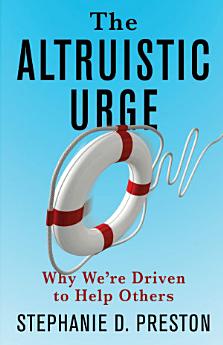
The Altruistic Urge: Why We’re Driven to Help Others
Stephanie D. Preston
May 2022 · Columbia University Press
Ebook
344
Pages
Tools
info
family_home
Eligible
info
About this ebook
Ordinary people can perform acts of astonishing selflessness, sometimes even putting their lives on the line. A pregnant woman saw a dorsal fin and blood in the water—and dove right in to pull her wounded husband to safety. Remarkably, some even leap into action to save complete strangers: one New York man jumped onto the subway tracks to rescue a boy who had fallen into the path of an oncoming train. Such behavior is not uniquely human. Researchers have found that mother rodents are highly motivated to bring newborn pups—not just their own—back to safety. What do these stories have in common, and what do they reveal about the instinct to protect others?
In The Altruistic Urge, Stephanie D. Preston explores how and why we developed a surprisingly powerful drive to help the vulnerable. She argues that the neural and psychological mechanisms that evolved to safeguard offspring also motivate people to save strangers in need of immediate aid. Eye-catching dramatic rescues bear a striking similarity to how other mammals retrieve their young and help explain more mundane forms of support like donating money. Merging extensive interdisciplinary research that spans psychology, neuroscience, neurobiology, and evolutionary biology, Preston develops a groundbreaking model of altruistic responses. Her theory accounts for extraordinary feats of bravery, all-too-common apathy, and everything in between—and it can also be deployed to craft more effective appeals to assist those in need.
In The Altruistic Urge, Stephanie D. Preston explores how and why we developed a surprisingly powerful drive to help the vulnerable. She argues that the neural and psychological mechanisms that evolved to safeguard offspring also motivate people to save strangers in need of immediate aid. Eye-catching dramatic rescues bear a striking similarity to how other mammals retrieve their young and help explain more mundane forms of support like donating money. Merging extensive interdisciplinary research that spans psychology, neuroscience, neurobiology, and evolutionary biology, Preston develops a groundbreaking model of altruistic responses. Her theory accounts for extraordinary feats of bravery, all-too-common apathy, and everything in between—and it can also be deployed to craft more effective appeals to assist those in need.
Ordinary people can perform acts of astonishing selflessness, sometimes even putting their lives on the line. A pregnant woman saw a dorsal fin and blood in the water—and dove right in to pull her wounded husband to safety. Remarkably, some even leap into action to save complete strangers: one Ne...
Discover more
About the author
Stephanie D. Preston is professor of psychology and director of the Ecological Neuroscience Lab at the University of Michigan. She is coeditor of The Interdisciplinary Science of Consumption (2014).
Stephanie D. Preston is professor of psychology and director of the Ecological Neuroscience Lab at the University of Michigan. She is coeditor of The Interdisciplinary Science of Consumption (2014).
Rate this ebook
Tell us what you think.
Reading information
Smartphones and tablets
Install the Google Play Books app for Android and iPad/iPhone. It syncs automatically with your account and allows you to read online or offline wherever you are.
Laptops and computers
You can listen to audiobooks purchased on Google Play using your computer's web browser.
eReaders and other devices
To read on e-ink devices like Kobo eReaders, you'll need to download a file and transfer it to your device. Follow the detailed Help Center instructions to transfer the files to supported eReaders.