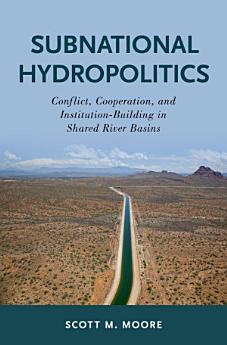
Subnational Hydropolitics: Conflict, Cooperation, and Institution-Building in Shared River Basins
Jun 2018 · Oxford University Press
Ebook
304
Pages
family_home
Eligible
info
About this ebook
The prospect of international conflict over water has long been the subject of academic and popular concern, but subnational political conflict is considerably more common, and almost certainly imposes greater economic and environmental costs. Indeed, subnational hydropolitics are an important feature of several large countries, including the United States, India, and China. Moreover, disputes between water users in shared river basins have often persisted despite repeated attempts by central governments to resolve them through both persuasion and coercion. Yet despite the growing threat of water scarcity around the world, little research exists on sub-national politics of shared water resources. This book attempts to fill the gap by explaining how and why hydropolitics play out within countries, as well as between them. Subnational Hydropolitics re-examines the issue of water conflict by examining conflicts at the subnational rather than international level. By examining several in-depth case studies of both conflict and cooperation, Scott Moore argues that increasing sub-national water conflict is driven by two inter-linked forces, identity politics, which gives subnational politicians a reason to compete over shared water resources; and political decentralization, which provides them with the tools to do so. To understand politics at the subnational level, the book blends insights from both the environmental governance and comparative politics literatures. By examining the challenges many countries face in achieving cooperation over shared water resources, the book helps to shed light on different mechanisms and processes for solving cooperation problems at the regional scale lessons relevant to tackling a wide range of transboundary environmental problems, including air pollution, urbanization, and ecosystem protection. But at its core, this book promises a definitive contribution to the growing sub-field of environmental politics, centered on understanding how different countries attempt to solve the problems inherent in governing water resources in shared river basins.
The prospect of international conflict over water has long been the subject of academic and popular concern, but subnational political conflict is considerably more common, and almost certainly imposes greater economic and environmental costs. Indeed, subnational hydropolitics are an important fe...
Discover more
About the author
Scott Moore is a scholar and policymaker focused on environmental issues, especially water resources, climate change, and oceans. His research and commentary on these issues has appeared in Nature, Foreign Affairs, and The New York Times. His work experience includes the U.S. State Department, where he led U.S. - China cooperation on climate change and ocean conservation, and the World Bank, where he led water sector institutional reform and financing projects as a Young Professional. He holds an undergraduate degree from Princeton, and a master's and doctoral degrees from Oxford University, where he was a Rhodes Scholar. He currently serves as a Senior Fellow of the Kleinman Center for Energy Policy at the University of Pennsylvania.
Scott Moore is a scholar and policymaker focused on environmental issues, especially water resources, climate change, and oceans. His research and commentary on these issues has appeared in Nature, Foreign Affairs, and The New York Times. His work experience includes the U.S. State Department, wh...
Rate this ebook
Tell us what you think.
Reading information
Smartphones and tablets
Install the Google Play Books app for Android and iPad/iPhone. It syncs automatically with your account and allows you to read online or offline wherever you are.
Laptops and computers
You can listen to audiobooks purchased on Google Play using your computer's web browser.
eReaders and other devices
To read on e-ink devices like Kobo eReaders, you'll need to download a file and transfer it to your device. Follow the detailed Help Center instructions to transfer the files to supported eReaders.