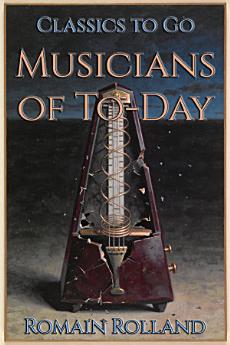
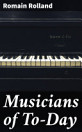
Musicians of To-Day: Restored Classics to Go Edition

· Otbebookpublishing
Ebook
349
Pages
Eligible

About this ebook

Musicians of To-Day gathers Romain Rolland's penetrating essays on the composers and currents that shaped modern music. With sympathy, scholarship, and a sharp critical eye, Rolland surveys figures such as Berlioz, Wagner, Saint-Saëns, d'Indy, Strauss, Hugo Wolf, Perosi, and Debussy, while also reflecting on French and German music and the musical awakening in Paris. These essays are not mere portraits or histories: they place art within the pressure of temperament, struggle, and culture, inviting readers to hear more intelligently and to balance feeling with understanding. The book's most powerful pages reconsider Hector Berlioz as a misunderstood genius—bold, dramatic, deeply French, and impossible to reduce to easy judgments. Rolland traces his contradictions, romantic obsessions, poverty, illness, and isolation, revealing a creator whose originality was often obscured by critics, institutions, and even his own unstable self-knowledge. Hugo Wolf is equally compelling: vilified by the musical establishment, he erupts in astonishing song cycles, then falls into silence, despair, and mental collapse. Across the volume, music becomes a living drama of genius, struggle, and artistic truth. This edition has been fully restored with modern typesetting, custom cover design.
Musicians of To-Day gathers Romain Rolland's penetrating essays on the composers and currents that shaped modern music. With sympathy, scholarship, and a sharp critical eye, Rolland surveys figures such as Berlioz, Wagner, Saint-Saëns, d'Indy, Strauss, Hugo Wolf, Perosi, and Debussy, while also r...

Discover more

About the author

Romain Rolland was a French novelist, biographer, essayist, and committed humanist whose life spanned a period of war, political upheaval, and artistic change, and whose work was shaped by a deep faith in the moral power of culture. Born in 1866 in central France, he studied at the École Normale Supérieure, taught history, and later devoted himself to writing with the conviction that literature and art should serve human dignity rather than nationalism or violence. He became widely admired for his large-scale fiction and for his critical and biographical studies of major artists and thinkers, especially his writings on music, which reveal both his scholarly range and his gift for making art feel urgently alive. Rolland's work often returns to the struggle between conscience and conformity, the search for spiritual freedom, and the hope that individuals can resist hatred through integrity, sympathy, and creative expression. During the First World War he was a prominent voice for peace, a stance that brought him criticism as well as lasting respect, and later he continued to write as a public intellectual committed to international understanding. He was awarded the Nobel Prize in Literature in 1915, an honor that recognized not only his artistry but also his ethical courage. Today, Rolland remains significant for readers interested in the meeting point of literature, history, music, and moral responsibility, and his legacy endures in his insistence that art can widen our sense of humanity. Readers drawn to thoughtful fiction, cultural biography, and works that explore ideals under pressure will find him especially rewarding.
Romain Rolland was a French novelist, biographer, essayist, and committed humanist whose life spanned a period of war, political upheaval, and artistic change, and whose work was shaped by a deep faith in the moral power of culture. Born in 1866 in central France, he studied at the École Normale ...

Rate this ebook

Tell us what you think.

Reading information

Smartphones and tablets
Install the Google Play Books app for Android and iPad/iPhone. It syncs automatically with your account and allows you to read online or offline wherever you are.
Laptops and computers
You can listen to audiobooks purchased on Google Play using your computer's web browser.
eReaders and other devices
To read on e-ink devices like Kobo eReaders, you'll need to download a file and transfer it to your device. Follow the detailed Help Center instructions to transfer the files to supported eReaders.