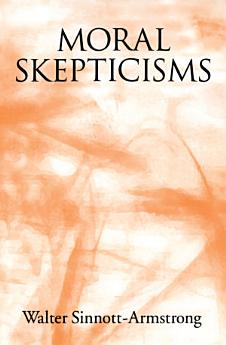
Moral Skepticism
Jan 2006 · Oxford University Press
Ebook
288
Pages
Tools
info
family_home
Eligible
info
About this ebook
All contentious moral issues--from gay marriage to abortion and affirmative action--raise difficult questions about the justification of moral beliefs. How can we be justified in holding on to our own moral beliefs while recognizing that other intelligent people feel quite differently and that many moral beliefs are distorted by self-interest and by corrupt cultures? Even when almost everyone agrees--e.g. that experimental surgery without consent is immoral--can we know that such beliefs are true? If so, how? These profound questions lead to fundamental issues about the nature of morality, language, metaphysics, justification, and knowledge. They also have tremendous practical importance in handling controversial moral questions in health care ethics, politics, law, and education. Sinnott-Armstrong here provides an extensive overview of these difficult subjects, looking at a wide variety of questions, including: Are any moral beliefs true? Are any justified? What is justified belief? The second half of the book explores various moral theories that have grappled with these issues, such as naturalism, normativism, intuitionism, and coherentism, all of which are attempts to answer moral skepticism. Sinnott-Armstrong argues that all these approaches fail to rule out moral nihilism--the view that nothing is really morally wrong or right, bad or good. Then he develops his own novel theory,--"moderate Pyrrhonian moral skepticism"--which concludes that some moral beliefs can be justified out of a modest contrast class but no moral beliefs can be justified out of an extreme contrast class. While explaining this original position and criticizing alternatives, Sinnott-Armstrong provides a wide-ranging survey of the epistemology of moral beliefs.
All contentious moral issues--from gay marriage to abortion and affirmative action--raise difficult questions about the justification of moral beliefs. How can we be justified in holding on to our own moral beliefs while recognizing that other intelligent people feel quite differently and that ma...
About the author
Walter Sinnott-Armstrong is Professor of Philosophy and Hardy Professor of Legal Studies, Dartmouth College. He is author of The Existence of God and editor of Pyrrhonian Skepticism.
Walter Sinnott-Armstrong is Professor of Philosophy and Hardy Professor of Legal Studies, Dartmouth College. He is author of The Existence of God and editor of Pyrrhonian Skepticism.
Rate this ebook
Tell us what you think.
Reading information
Smartphones and tablets
Install the Google Play Books app for Android and iPad/iPhone. It syncs automatically with your account and allows you to read online or offline wherever you are.
Laptops and computers
You can listen to audiobooks purchased on Google Play using your computer's web browser.
eReaders and other devices
To read on e-ink devices like Kobo eReaders, you'll need to download a file and transfer it to your device. Follow the detailed Help Center instructions to transfer the files to supported eReaders.