About this ebook
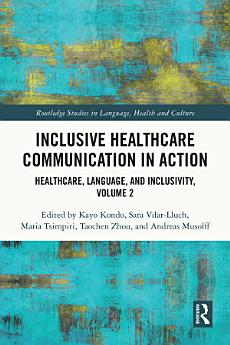
Building on the foundations in Discourses of Inclusive and Exclusionary Health Communication: Healthcare, Language, and Inclusivity, Volume 1, this volume examines scientific and institutional discourses, community health campaigns, and health education initiatives, while addressing topics such as AI technologies, gender-inclusive language, graphic medicine, and youth health education. The contributors employ a range of linguistics and health communication methods, including corpus-assisted discourse analysis, multimodal and narrative approaches, and participatory research. Contributions include cross-cultural case studies, community-based projects, and innovative applications of machine learning. The volume emphasizes how strategies of inclusive communication can help counter structural barriers and promote more equitable practices.
Together with Volume 1, this is an essential resource for academics working in linguistics and discourse studies applied to healthcare, as well as students seeking to understand how language both reflects and transforms health inequalities, while providing globally relevant perspectives and practical tools for effective healthcare communication.
Discover more
About the author
Kayo Kondo is Lecturer in Japanese Studies at the School of Modern Languages and Cultures, Durham University, UK. Her research collaborations extend across the UK and Japan, where she works closely with health and social care practitioners through research projects and academic seminars.
Sara Vilar-Lluch is Lecturer in Language and Linguistics at Cardiff University, Wales, UK. Her research interests are in discourse analysis, corpus linguistics and Systemic Functional Linguistics, particularly as applied to health communication. Recent studies include applications to health guidance and immunization discourses.
Maria Tsimpiri is a linguist with a research background in (im)politeness, cross-linguistic influence, and speech acts, and how their dynamic shift impacts global communication. Her pedagogical affiliation is with the University of East Anglia, UK. She is the founder and director of Logos UK.
Taochen Zhou is the Chinese Language Teaching and Learning Officer at the Confucius Institute at the University of Sheffield with a PhD in Applied Linguistics. Her research interests and publications focus on metaphor analysis, functional grammar, language acquisition, and language and aging.
Andreas Musolff is Professor Emeritus of Intercultural Communication at the University of East Anglia, Norwich, UK. He has published widely on Political Discourse and Figurative Language.